Real world clinical outcomes of fixed dose intravenous insulin compared to nurse led glucose adjusted intravenous insulin in the management of diabetic ketoacidosis patients in the high dependency or intensive care unit in a single-centre retrospective observational cohort study (#336)
Diabetic ketoacidosis (DKA) is an endocrine emergency managed with intravenous insulin. Fixed rate intravenous insulin is recommended in American Diabetic Association (ADA) (1) and Joint British Diabetes Society (2) guidelines, where ADA also recommends a nurse-led glucose-adjusted intravenous insulin protocol. Real-world evidence comparing both protocols remain limited. In Singapore, DKA management with nurse-led glucose-adjusted intravenous insulin is standard of care given the theoretical benefit in reducing hypokalemia and hypoglycemia events necessitating stopping intravenous insulin. This study aims to evaluate the outcomes in DKA patients receiving nurse-led glucose-adjusted compared with fixed rate intravenous insulin.
We conducted a retrospective cohort study in DKA patients meeting ADA 2026 DKA diagnostic criteria (3) admitted to Tan Tock Seng Hospital critical care units who received nurse-led glucose-adjusted or fixed dose intravenous insulin. Clinical outcomes reviewed were DKA duration, critical care length of stay and hospital length of stay. Adverse events reviewed were rates of hypokalemia and hypoglycemia necessitating stopping intravenous insulin. Subgroup analysis to evaluate outcomes in severe DKA patients meeting ADA severe DKA 2024 criteria (1) were performed. Categorical variables were evaluated with Chi squared and Fisher’s exact test. Continuous variables were evaluated with t-test and Mann-Whitney U test.
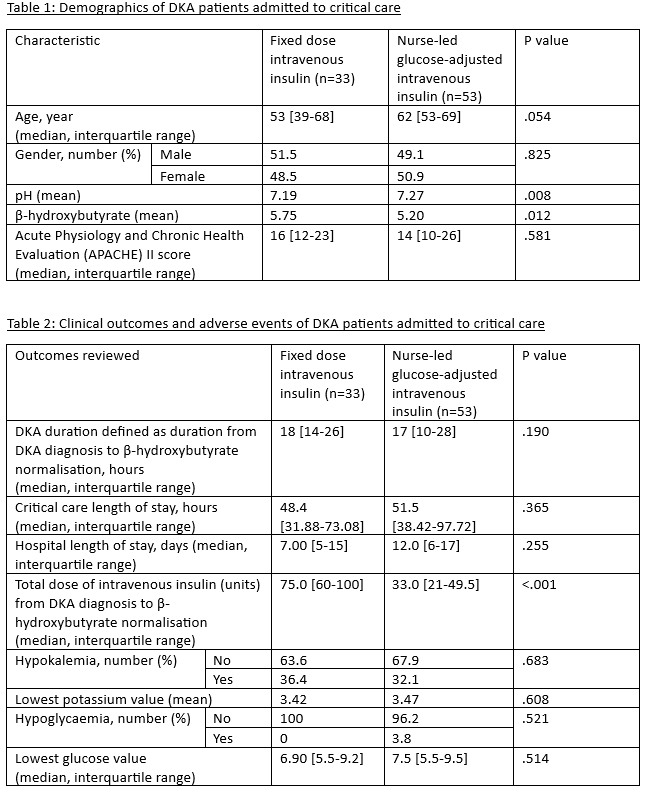
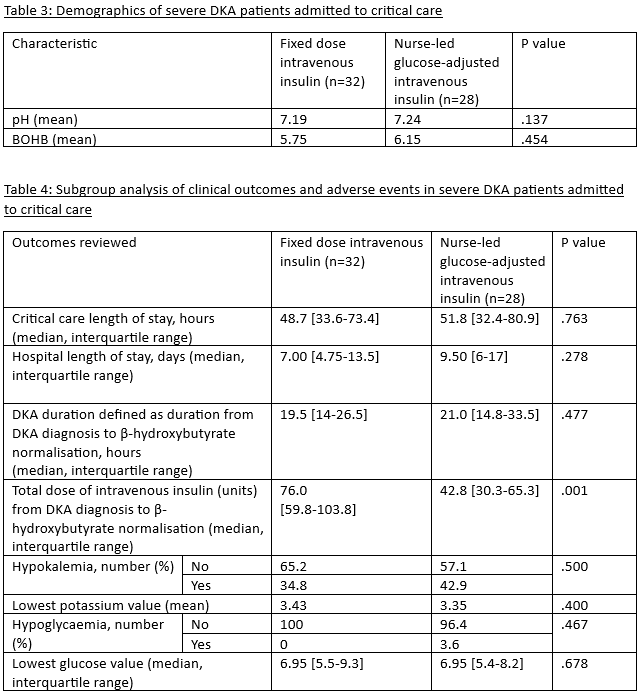
Among 86 DKA patients (50% male, median age 59.5), 33 received fixed dose intravenous insulin and 53 received nurse-led glucose-adjusted intravenous insulin (Table 1). For all DKA patients reviewed, there was no significant differences in clinical outcomes or adverse events (P >.05) (Table 2). In subgroup analysis of severe DKA patients, there was also no significant differences in clinical outcomes or adverse events (P>.05) (Table 3, 4).
In DKA, delivery of intravenous insulin via nurse-led glucose-adjusted or fixed dose protocols both appear effective and safe. Further prospective multi-center data is needed to evaluate if outcomes differ in varying populations to better guide current recommendations.
- (1) Umpierrez GE, Davis GM, ElSayed NA, et al. Hyperglycemic crises in adults with diabetes: A consensus report. Diabetes Care. 2024;47(8):1257-1275. doi:https://doi.org/10.2337/dci24-0032
- (2) Joint British Diabetes Societies for Inpatient Care. The Management of Diabetic Ketoacidosis in Adults.; 2023. https://abcd.care/sites/default/files/site_uploads/JBDS_Guidelines_Current/JBDS_02_DKA_Guideline_with_QR_code_March_2023.pdf
- (3) Bajaj M, McCoy RG, Balapattabi K, et al. 16. Diabetes Care in the Hospital: Standards of Care in Diabetes—2026. Diabetes Care. 2025;49(Supplement_1):S339-S355. doi:https://doi.org/10.2337/dc26-s016