Hyperacute Sheehan syndrome with pituitary infarction following massive postpartum haemorrhage from placenta accreta spectrum (#448)
Sheehan syndrome is a rare cause of postpartum hypopituitarism resulting from pituitary ischaemic necrosis after postpartum haemorrhage, classically presenting months to years after delivery[1]. Acute presentations are uncommon but relevant in high-risk obstetric populations. We report a case of hyperacute Sheehan syndrome with pituitary infarction following catastrophic haemorrhage in the setting of placenta accreta spectrum.
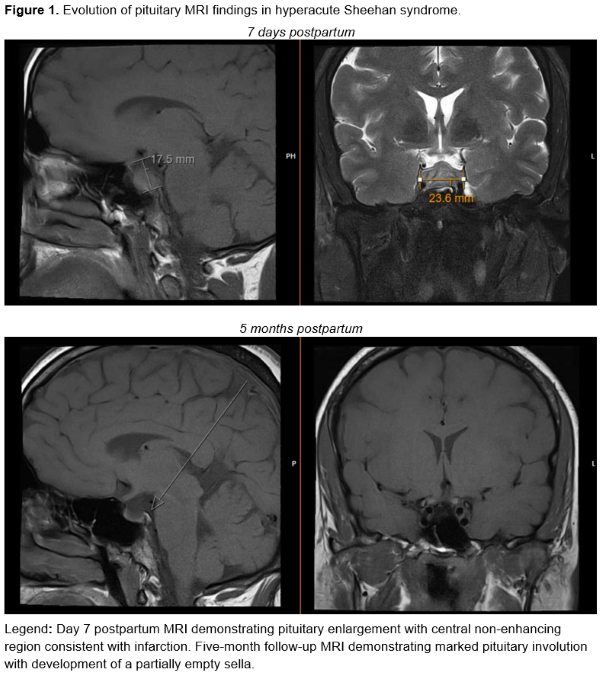
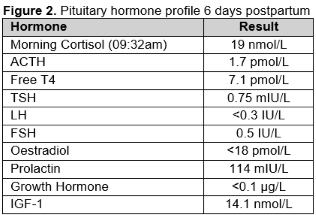
A 39-year-old woman (G10/P8) with placenta praevia and suspected placenta accreta spectrum underwent caesarean section, bilateral salpingectomy and total abdominal hysterectomy at 34+5 weeks gestation. The procedure was complicated by a 6-litre postpartum haemorrhage, requiring massive transfusion and ICU admission. By day-3 postpartum, she developed severe headache, postural dizziness, peripheral visual field disturbances and agalactia. CT brain demonstrated mild pituitary enlargement, initially considered within physiological postpartum limits. On day-6 postpartum, panhypopituitarism was identified with hypocortisolaemia, central hypothyroidism, hypogonadism, low IGF-1 and inappropriately low prolactin. MRI pituitary demonstrated an enlarged gland with a central non-enhancing region consistent with acute infarction. Hydrocortisone replacement was commenced, followed by levothyroxine. She had persistent hypopituitarism and marked pituitary involution on interval imaging.
Sheehan syndrome remains uncommon but clinically important, particularly as rising rates of placenta accreta spectrum and complex caesarean delivery increase the risk of severe obstetric haemorrhage[2,3]. Acute presentations can occur within days, with symptoms that can be easily misattributed to physiological postpartum or post-surgical changes. Initial imaging may appear normal or show mild pituitary enlargement, emphasising the importance of maintaining a high index of suspicion and considering repeat imaging when clinical concern persists. Subsequent imaging can reveal evolution of the pituitary gland into an “empty sella” appearance. This case highlights that acute Sheehan syndrome can present as an endocrine emergency shortly postpartum, especially in women with major postpartum haemorrhage, agalactia, visual symptoms or unexplained hypotension. Normal early imaging should not delay urgent endocrine assessment and glucocorticoid replacement.
- Karaca, Z., Laway, B. A., Dokmetas, H. S., Atmaca, H., & Kelestimur, F. (2016). Sheehan syndrome. Nature reviews. Disease primers, 2, 16092. https://doi.org/10.1038/nrdp.2016.92
- American College of Obstetricians and Gynecologists, & Society for Maternal-Fetal Medicine (2018). Obstetric Care Consensus No. 7: Placenta Accreta Spectrum. Obstetrics and gynecology, 132(6), e259–e275. https://doi.org/10.1097/AOG.0000000000002983
- Jauniaux, E., Aplin, J. D., Fox, K. A., Afshar, Y., Hussein, A. M., Jones, C. J. P., & Burton, G. J. (2025). Placenta accreta spectrum. Nature reviews. Disease primers, 11(1), 40. https://doi.org/10.1038/s41572-025-00624-3