Age-Specific Associations Between Sarcopenia and Mortality (#353)
Background
While prior research has predominantly concentrated on older adults, the clinical implications of sarcopenia in younger populations remain insufficiently characterized. This study aimed to evaluate the association between low muscle mass and mortality across different age groups.
Methods
We analyzed data from the National Health and Nutrition Examination Survey 1999–2006 and linked mortality data from the National Center for Health Statistics. A total of 15,141 adults aged ≥20 years were included. Low muscle mass was defined using sex-specific appendicular skeletal muscle mass divided by height squared (ASM/height²) cutoffs based on the European Working Group on Sarcopenia in Older People 2 (EWGSOP2) definition for low muscle quantity: <7.0 kg/m² in men and <5.5 kg/m² in women. Complex survey Cox proportional hazards models assessed associations with all-cause and cause-specific mortality.
Results
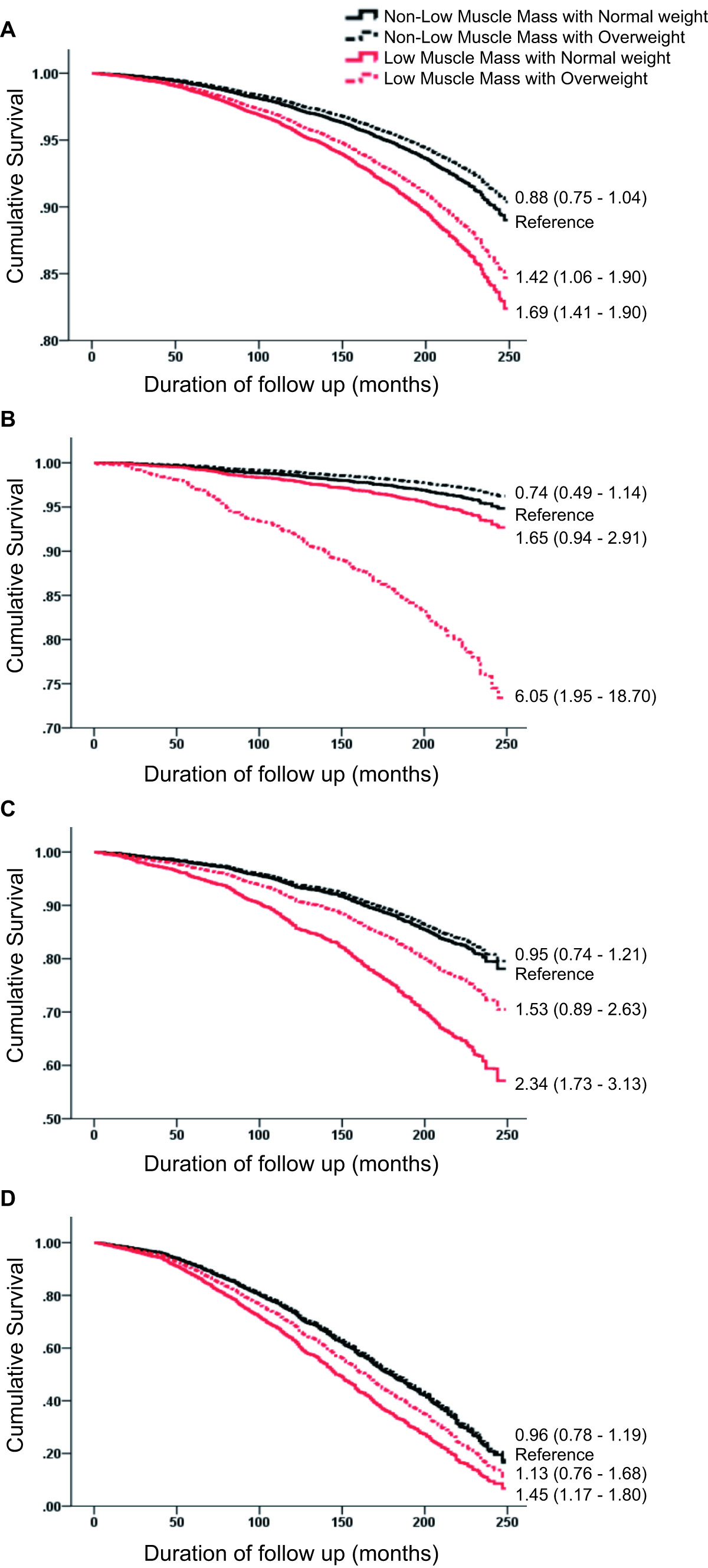
Low muscle mass was associated with increased all-cause mortality across age groups. In the fully adjusted model, the hazard ratio for all-cause mortality was 1.75 (95% confidence interval [CI], 1.51–2.04) overall, 2.30 (95% CI, 1.38–3.84) in adults aged 20–49 years, 2.27 (95% CI, 1.77–2.91) in those aged 50–64 years, and 1.39 (95% CI, 1.13–1.70) in those aged ≥65 years. Cause-specific and body mass index (BMI)-stratified patterns differed by age (Figure) : low muscle mass was associated with malignant mortality in adults aged 20–49 years, broader cause-specific mortality in adults aged 50–64 years, and cardiometabolic and other-cause mortality in adults aged ≥65 years.
Conclusion
Low muscle mass was associated with increased mortality across adulthood, with age-specific patterns by cause of death and BMI status. These findings support age-specific approaches to identifying and managing low muscle mass.