Determinants of Serum Testosterone in US Adult Men with Obesity (#368)
Background: Obesity is associated with lower serum testosterone (T) and sex hormone binding globulin (SHBG) concentrations relative to normal weight men. However, the complex interplay between adiposity and their effect on serum T and SHBG concentrations remain incompletely understood.
Methods: A cross-sectional analysis of NHANES 2021-2023 database to identify clinical and biochemical factors associated with population level decreases in serum T. Age, anthropometric variables (height, weight, BMI, waist, hip and arm circumferences, waist-hip ratio), and serum SHBG, LH and FSH were analysed in 2276 men, excluding presumed primary hypogonadism (FSH >15 IU/L) and exogenous T use (serum T >56 nmol/L). Univariate and multivariate stepwise linear regression analysis was performed with a p-value <0.05 considered significant.
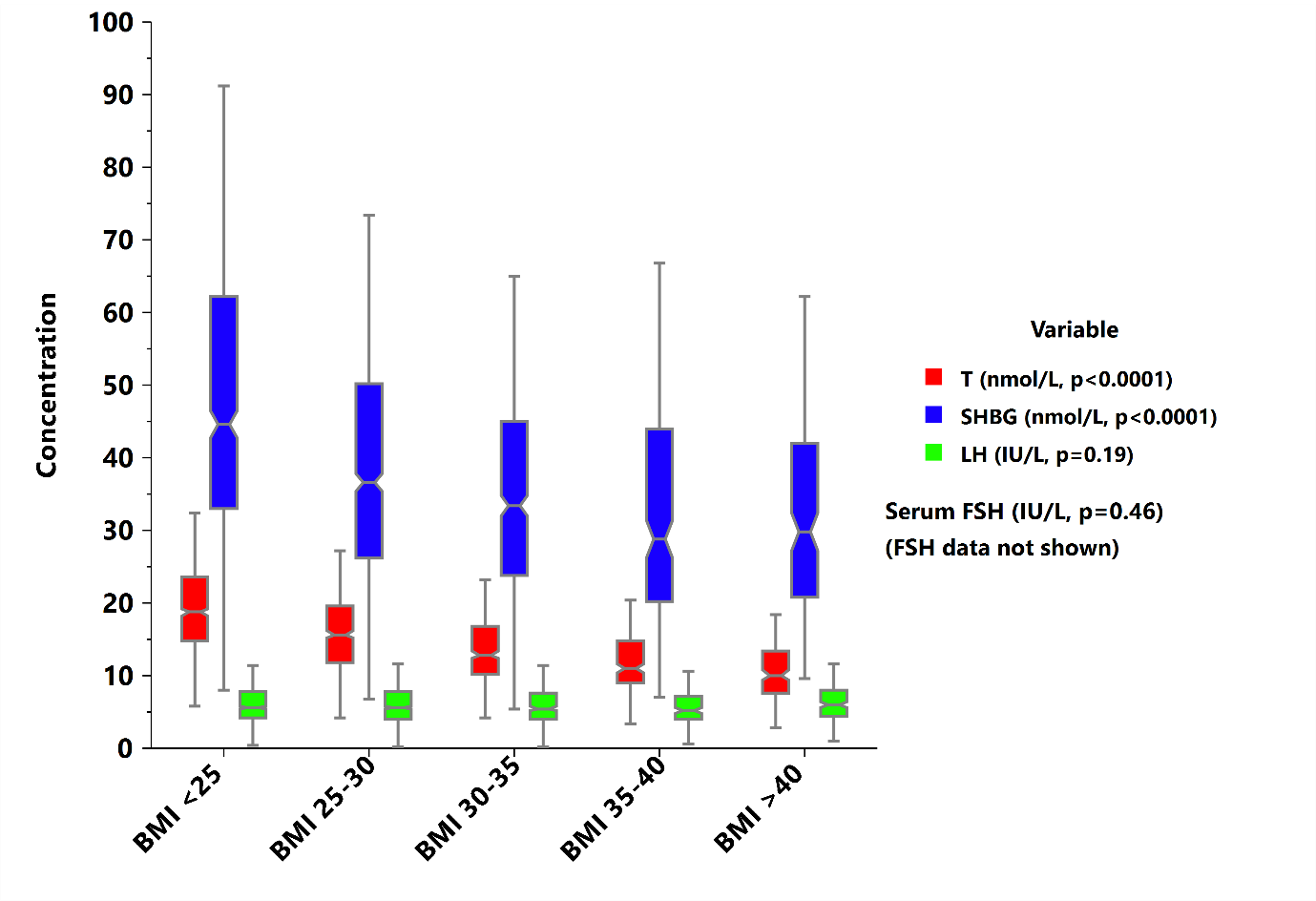
Results: Progressive increases in BMI were associated with progressive decreases in T and SHBG without any significant change in serum LH or FSH (Figure1). In univariate analysis, all anthropometric measurements (except height) were inversely correlated with T. In stepwise regression, the strongest consistent predictor of T across all BMI categories was SHBG (β=0.57, p<0.0001) with WC inversely associated with T in men with BMI <35 kg/m2 (β=-0.11 in overweight and β=-0.13 in class I obesity, p<0.0001) but not significant in men with BMI ≥35kg/m2. A non-linear association between BMI/WC and serum T plateaus indicating that the decline in T with increasing adiposity reaches a threshold.
Conclusions: In men with obesity, serum T was reduced proportionately with SHBG, and inversely with anthropomorphic measures of adiposity. Despite low serum T, serum LH and FSH remained normal unrelated to increasing BMI or decreasing T/SHBG consistent with eugonadism. WC, hip and arm circumferences and waist-to-hip ratio, can contribute to BMI in the clinical assessment of low serum T in men with obesity.
Figure 1: Box and whiskers plot of T, SHBG and LH across BMI class