Urban-rural disparities in bone architecture, geometry and strength among older adults: a population-based study from The Gambia, West Africa (#300)
Background: Across Africa, rapid population ageing, urbanisation and nutrition transition pose challenges to musculoskeletal health. However, few studies have investigated potential rural-urban differences in bone architecture. We aimed to establish rural-urban differences using a population-based study in The Gambia, West Africa.
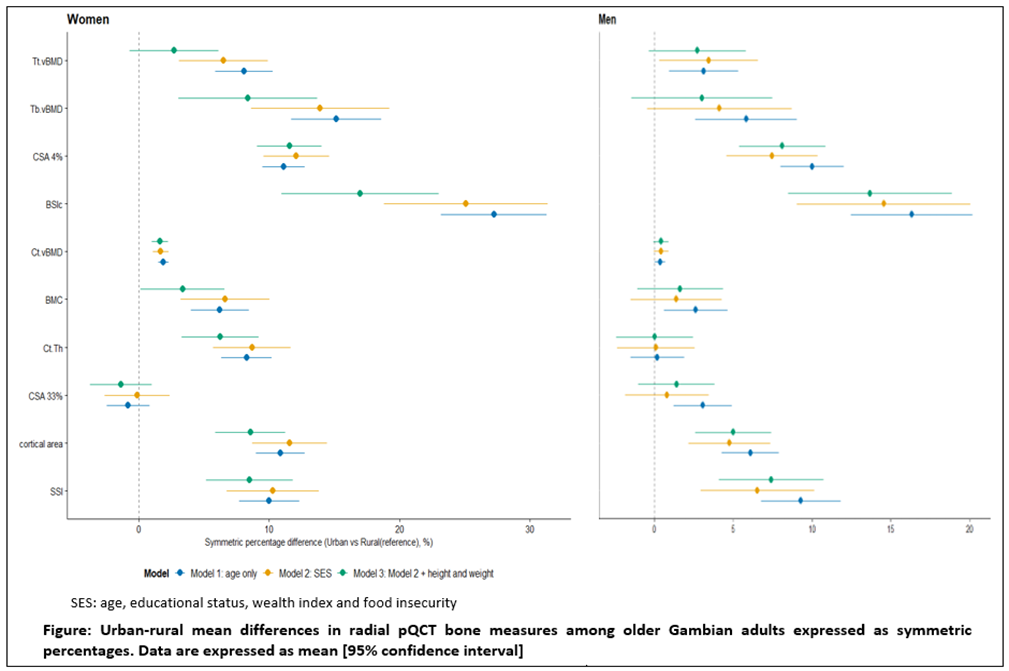
Methods: This population-based cross‑sectional study included Gambian adults aged ≥40 years, recruited using sex-and age-stratified random sampling from urban Brufut/Sukuta and rural West Kiang. Radial peripheral quantitative computed tomography (pQCT) scanning (at distal (4%) and proximal (33%) sites) measured total volumetric bone mineral density (Tt.vBMD), trabecular vBMD (Tb.vBMD), cross-sectional area (CSA), bone strength index of compression (BSIc), cortical vBMD (Ct.vBMD), bone mineral content (BMC), cortical thickness (Ct.Th), proximal CSA, cortical area and stress-strain index (SSI). Sex‑stratified linear regression models estimated rural‑urban mean differences in bone measures as symmetric percents, adjusted for age only (model 1), adjusted for socioeconomic factors (model 2), and finally for height and weight (model 3).
Results: A total of 1900 adults underwent pQCT measurements (52.3% F, 50% urban; mean [SD] age 61[13] years). Urban adults had greater distal radius CSA and BSIc before and after adjustment. Greater Tt.vBMD and Tb.vBMD were largely attenuated by weight adjustment, except for a residual 8.4% higher Tb.vBMD [95% CI: 3.0%, 13.7%] in females. Urban females had greater proximal radius Ct.vBMD (1.6% [1.0%, 2.2%]), cortical BMC (3.4% [0.1%, 6.6%]), Ct.Th (6.2% [3.3%, 9.2%]), cortical area (8.6% [5.9%, 11.2%]), and SSI (8.5% [5.2%, 11.8%]) than rural females before and after full adjustment. In males, differences were fewer, with urban residence associated with greater cortical area and SSI after full adjustment.
Conclusions: Urban residence was associated with better radial bone vBMD and estimated strength, with more pronounced differences observed in females. These findings highlight the need to include both rural and urban populations in studies of fracture epidemiology in African populations.