MRI apparent diffusion coefficient does not correlate with dopamine agonist use in prolactinomas (#307)
Introduction
Magnetic resonance imaging (MRI) diffusion-weighted imaging (DWI) enables quantitative texture analysis by measuring the apparent diffusion coefficient (ADC), which reflects water-molecule diffusion and infers cellular density.1 Low ADC has been associated with fibrosis in the liver,2 and dopamine agonist (DA) has been associated with iatrogenic fibrosis in prolactinomas3 with less favourable surgical outcomes.4 We aimed to evaluate the association between ADC and DA use in prolactinomas.
Methods
Patients with histopathologically confirmed prolactinoma (Jan 2016–Feb 2026) were identified from the hospital pituitary database. Those without pre-operative MRI DWI or available ADC due to artefact were excluded. Two radiologists, blinded to the clinical data, independently evaluated serial pre-operative MRIs. The ADC values from their paired measurements were averaged per scan prior to analysis. DA exposure duration and cumulative dose at the time of scan were evaluated.
Results
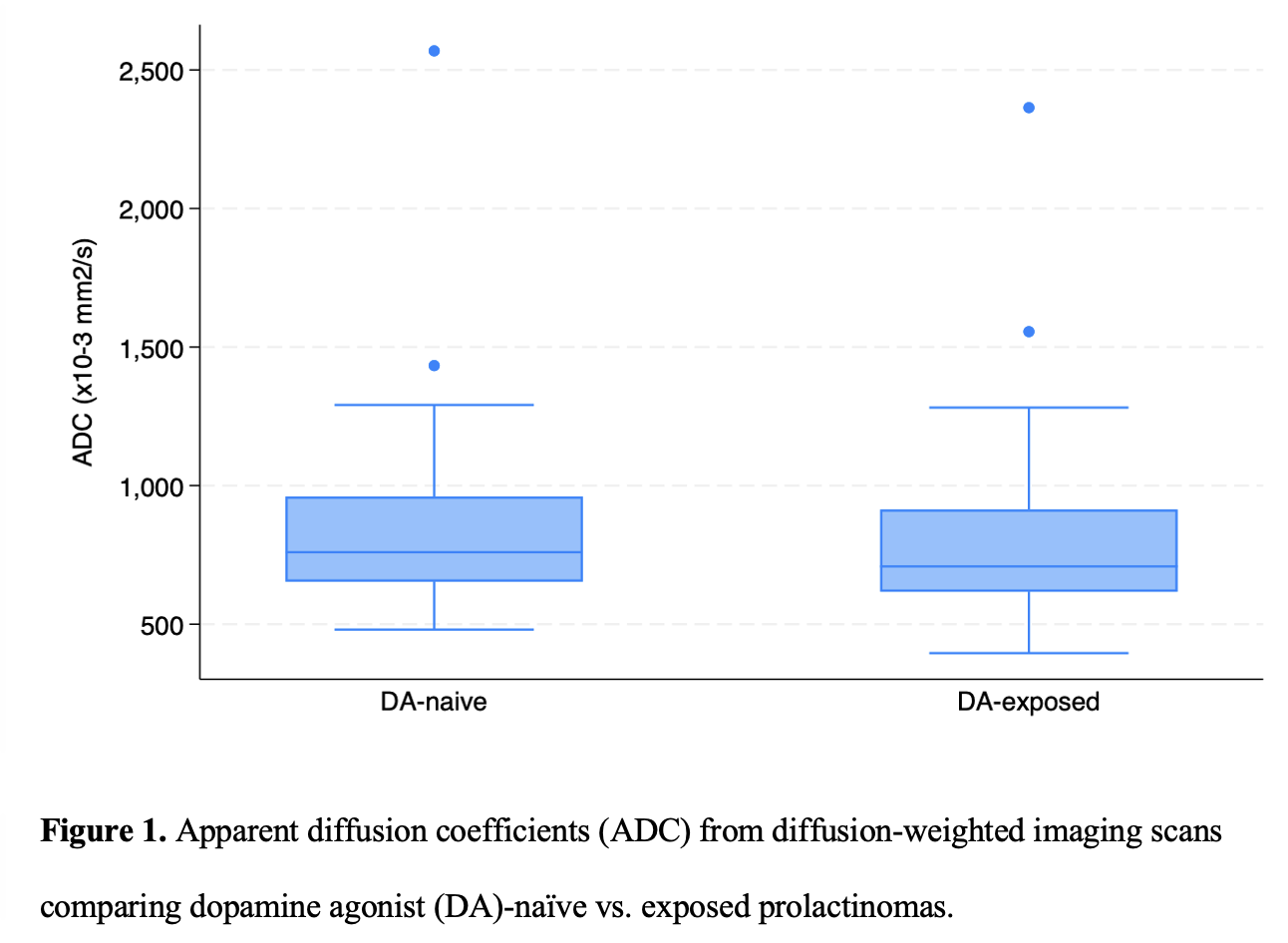
Fifty-three DWI scans from 34 patients with prolactinomas were included; four patients had three scans, 11 had two, and 19 had one scan. Twenty-eight scans were DA-naïve, and twenty-five were DA-exposed. ADC was not associated with DA exposure (n=25 DA-exposed, 709 [617-914] vs. n=28 DA-naïve, 760 [654-961]x10-3 mm²/s; p=0.49, Figure 1). Neither duration (p=0.12) nor maximum cabergoline dose per week (p=0.16) was associated with ADC. In paired patient analyses, cumulative cabergoline dose was not significantly associated with ADC (β=-0.039, 95% CI [-0.40, 0.32], p=0.83). ADC was not associated with initial prolactin level (p=0.67), tumour volume (p=0.97), cavernous sinus invasion (p=0.94), Ki67 (p=0.87), granulation patterns (p=0.12), or bromocriptine use (p=0.13).
Conclusions
Our study demonstrated no significant correlation between ADC and dopamine agonist use. Our study is limited by its retrospective design, the low use of bromocriptine for comparison with cabergoline, and a small sample size. Larger studies are warranted to evaluate ADC as a potential prognostic tool for iatrogenic fibrosis before operative management.
- Sener RN. Diffusion MRI: apparent diffusion coefficient (ADC) values in the normal brain and a classification of brain disorders based on ADC values. Comput Med Imaging Graph. 2001;25(4):299-326.
- Sandrasegaran K, Akisik FM, Lin C, Tahir B, Rajan J, Saxena R, et al. Value of diffusion-weighted MRI for assessing liver fibrosis and cirrhosis. AJR Am J Roentgenol. 2009;193(6):1556-60.
- Menucci M, Quiñones-Hinojosa A, Burger P, Salvatori R. Effect of dopaminergic drug treatment on surgical findings in prolactinomas. Pituitary. 2011;14(1):68-74.
- Ryba A, Gonzalez Lopez D, Rotermund R, Flitsch J. Preoperative treatment with dopamine agonist therapy influences surgical outcome in prolactinoma: a retrospective single-center on 159 patients. Acta Neurochir (Wien). 2024;166(1):316.