Elevated serum total testosterone - the unexpected clue in the diagnosis of Wilson’s disease (#432)
Case Study
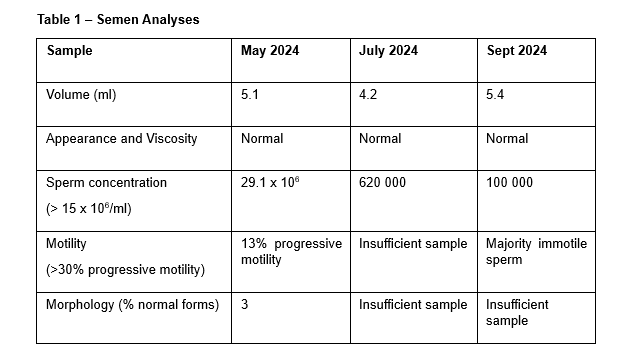
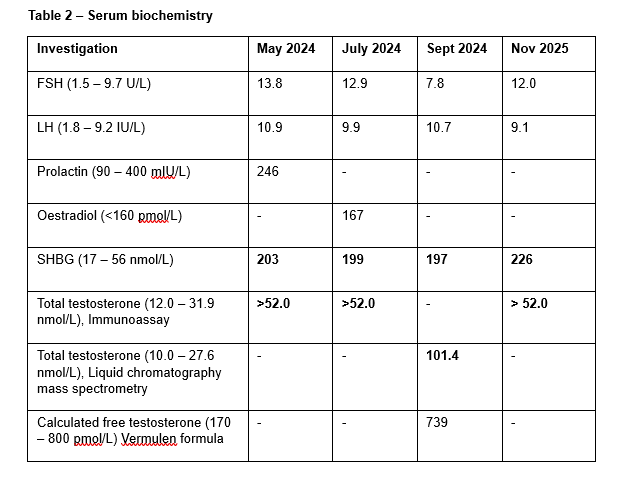
A thirty-year-old gentleman presented with primary infertility after inability to conceive for fifteen months. Medical history was significant for obesity with body mass index of 40kg/m2. He was on no regular medications. On physical examination, he has well-virilised with testicular volumes of 15ml bilaterally. Serial investigations revealed progressive oligospermia (Table 1), whilst total testosterone concentrations were unexpectedly unrecordably high (>52nmol/L) and accompanied by marked elevation in serum hormone binding globulin (SHBG) concentrations (Table 2). Despite normal liver function tests (LFTs), liver imaging demonstrated cirrhosis. Hepatitic screen identified a reduced serum ceruloplasmin level and an elevated 24-hour urinary copper excretion. Our patient was diagnosed with Wilson’s disease and was commenced on penicillamine.
Discussion
Total testosterone (TTe) concentrations reflect both free and protein-bound testosterone proportions1. Approximately 50% of protein-bound testosterone is bound to SHBG with high affinity1. TTe can therefore be inaccurate where SHBG concentrations are altered2. The role of measuring calculated free testosterone levels when TTe levels are unreliable remains debated given no consensus regarding a standardised formula3.
Elevated serum total testosterone levels in conjunction with elevated SHBG concentrations should prompt investigation into the underlying aetiology1. Causes of increased SHBG concentrations include hyperthyroidism, elevated oestrogen states such as chronic liver disease and pregnancy, and medications including the oral contraceptive pill1. Our case highlights the need to exclude cirrhosis despite normal LFTs.
- Anna L Goldman, Shalender Bhasin, Frederick C W Wu, Meenakshi Krishna, Alvin M Matsumoto, Ravi Jasuja. (2017). A Reappraisal of Testosterone’s Binding in Circulation: Physiological and Clinical Implications, Endocrine Reviews, 38(4), 302–324
- Grossmann M. (2018). Biochemical evaluation of male androgen status: Beyond total testosterone. Clinical endocrinology, 88(4), 538–540.
- Nyamaah, Jennifer Afrakomaa; Narinx, Nicka,b; Antonio, Leena,c; Vanderschueren, Dirka,c. (2024) Use of calculated free testosterone in men: advantages and limitations. Current Opinion in Endocrinology & Diabetes and Obesity 31(6), 230-235