Beyond glucose: OGTT-derived insulin measures and future type 2 diabetes in women with PMOS (#318)
Aims
Women with polyendocrine metabolic ovarian syndrome (PMOS) (1) are at increased risk of type 2 diabetes (T2D) (2,3). Current screening uses fasting and 2-hour oral glucose tolerance test (OGTT) glucose measurements. Insulin measurement is not recommended. We aimed to characterise OGTT-derived glucose and insulin indices in women with PMOS and assess their association with subsequent T2D identified through data linkage.
Methods
Women with NIH-defined PMOS were retrospectively identified from endocrinology clinics in Western Australia. Paired glucose and insulin concentrations at 0, 60 and 120 minutes during a 75-g OGTT were analysed. HOMA-IR, Matsuda index, insulinogenic index (IGI), and glucose and insulin area under the curve (AUC) were calculated. Baseline status was classified as normal glucose tolerance (NGT), impaired fasting glucose (IFG), impaired glucose tolerance (IGT) and T2D. Linked data, with 30 years’ average follow up, obtained from the WA Data Linkage System, identified subsequent T2D diagnoses. Baseline metabolic measures were compared between women with and without T2D using Mann-Whitney U tests. Incremental prediction modelling evaluated whether OGTT-derived measures improved discrimination beyond conventional glucose measures.
Results
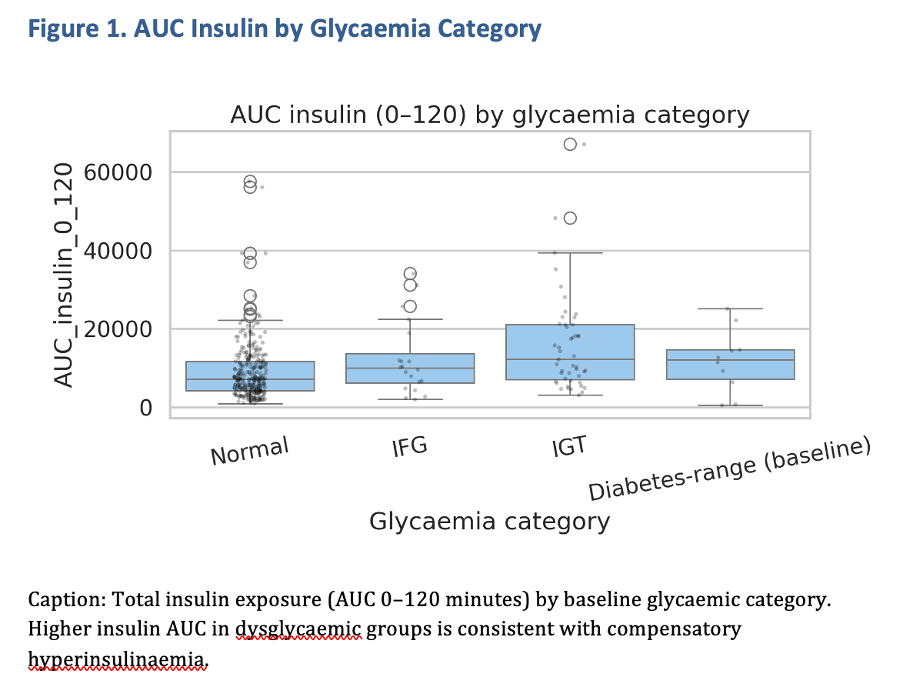
Of 410 women with complete OGTT data, 60 (14.6%) subsequently developed T2D, including 44 (73.3%) with normal baseline fasting and 2-hour glucose. Among women with baseline NGT, adding 2-hour insulin to a model including BMI, fasting and 2-hour glucose modestly improved prediction of T2D (AUC 0.746 to 0.764; likelihood-ratio p=0.019), whereas adding 1-hour glucose did not significantly improve prediction (AUC 0.754; p=0.176). Women who developed T2D also demonstrated higher fasting, 60-minute and 120-minute insulin concentrations, insulin AUC and HOMA-IR, and lower Matsuda index.
Conclusion
Conventional glucose-based OGTT interpretation classified nearly three-quarters of women who subsequently developed T2D as having NGT at baseline. OGTT-derived insulin measures, particularly 2-hour insulin, may improve long-term risk stratification beyond conventional glucose measures in women with PMOS.
- 1. Burns KA Polycystic ovary syndrome: dissecting the genetics, phenotype and health outcomes of a heterogeneous condition UWA Research Repository, PhD Thesis 2024.
- 2. Teede HJ, Tay CT, Laven JJE, Dokras A, Moran LJ, Piltonen TT, Costello MF, Boivin J, Redman LM, Boyle JA, Norman RJ. Recommendations from the 2023 international evidence-based guideline for the assessment and management of polycystic ovary syndrome. Eur J Endocrinol. 2023;189(2):G43-G64.
- 3. Belsti Y, Enticott J, Azumah R, Tay CT, Moran LJ, Ma RCW, Joham AE, Laven JSE, Teede HJ, Mousa A. Diagnostic accuracy of oral glucose tolerance test, fasting plasma glucose and HbA1c for type 2 diabetes in women with polycystic ovary syndrome: a systematic review and meta-analysis. Diabetes Metab Syndr Clin Res Rev. 2024;18(5):103246.