Seminal plasma extracellular vesicles partially restore sperm immune architecture disrupted by cryopreservation in the ram (#468)
Successful sperm transport through the ovine cervix requires coordinated interaction between spermatozoa and the female immune system. Cryopreservation disrupts this balance, reducing fertility following cervical artificial insemination and altering immune responses. We previously showed that seminal plasma (SP) reduces neutrophil binding and that complement influences sperm opsonisation in sheep. Complement activity is regulated by soluble and membrane-associated complement regulatory proteins (Cregs), yet their role in reproduction remains poorly understood. We therefore hypothesised that exposure to seminal plasma at ejaculation establishes an organised complement-regulatory architecture on the sperm surface that is disrupted by cryopreservation, influencing sperm survival in the tract.
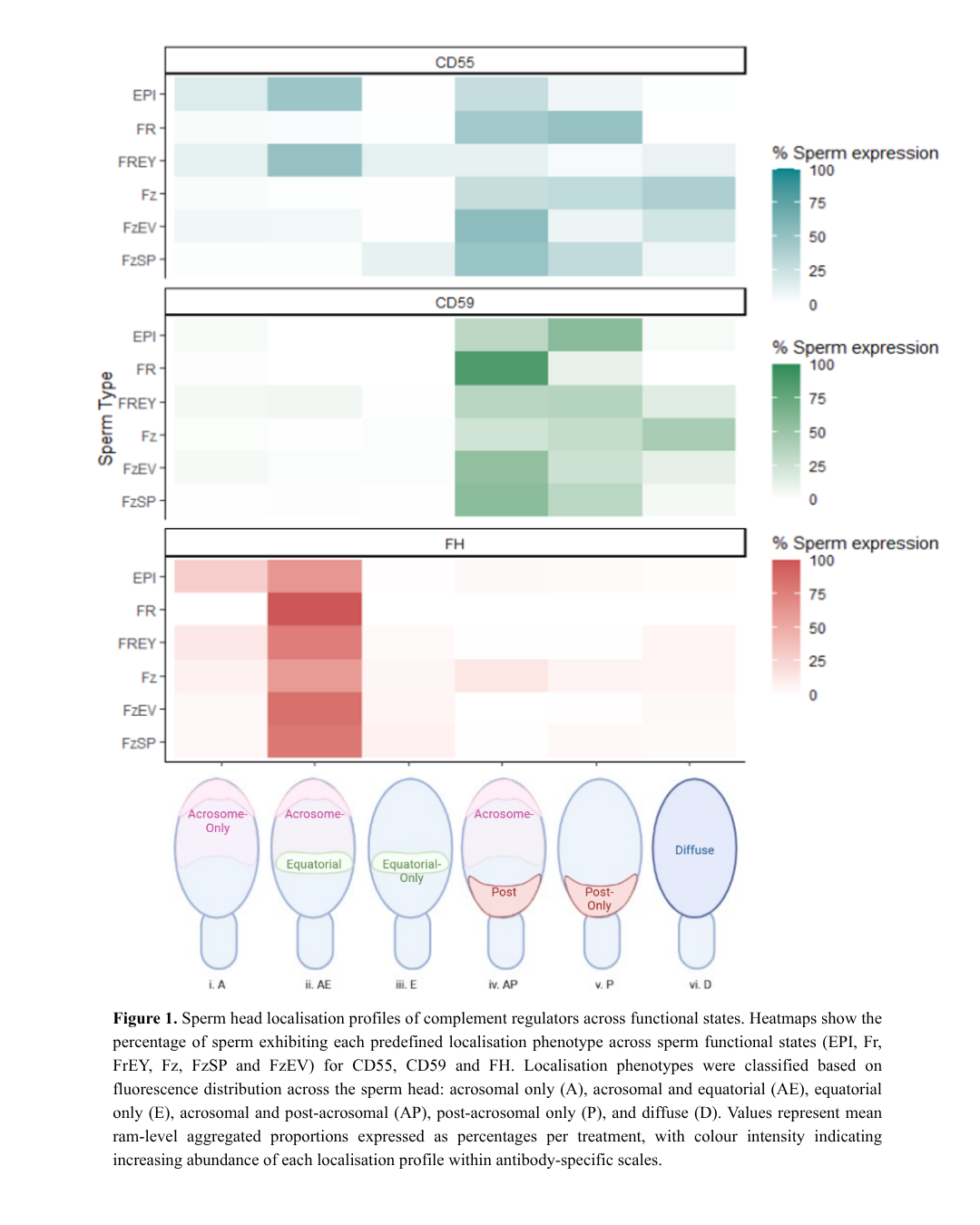
Immunofluorescence microscopy was used to quantify the mean fluorescence intensity (MFI) and characterise surface localisation profiles of complement regulators CD55, CD59 and Factor H (FH) across six sperm functional states (n = 10 rams): epididymal (EPI), fresh (Fr), cryodiluent-exposed (FrEY), cryopreserved (Fz), SP-supplemented (FzSP) and EV-supplemented (FzEV). MFI of 29,637 cells was quantified using ImageJ, while localisation was assigned to predefined sperm head fluorescence patterns.
SP exposure reorganised complement regulator localisation into distinct, uniform sperm surface profiles. Cryopreservation reduced MFI (CD55: 76.24 ± 16.24 to 60.98 ± 9.69, n.s; CD59: 132.39 ± 9.31 to 57.05 ± 5.83; FH: 182.87 ± 13.85 to 71.54 ± 8.89; p<0.0001) and increased diffuse localisation across all Cregs (Figure.1). Post-thaw supplementation partially restored both expression and spatial organisation similar to that exhibited in Fr sperm, with EVs outperforming whole SP.
These findings reveal that sperm immune identity is shaped by Creg organisation as well as abundance, which may contribute to sperm recognition and tolerance within the female reproductive tract compared with pathogen-driven immune activation. Cryopreservation disrupts this complement-regulatory architecture established during ejaculation, while SPEVs partially restore the sperm immune landscape, providing a promising strategy to improve immune compatibility and fertility of cryopreserved ram sperm.