An intervention to improve uterine contractility in advanced maternal ageing? Subtle reproductive effects of advanced maternal age and dietary γ-linolenic acid supplementation in parous mice (#511)
 Background: An increasing proportion of births are occurring in older women, who are less likely to enter labour spontaneously and have poorer responses to oxytocin than younger women, with lower prostaglandin synthesis implicated. In young pregnancies, prostaglandin synthesis can be upregulated by dietary linoleic acid supplementation. However, expression of Δ6-desaturase, required to synthesise prostaglandins from linoleic acid decreases in ageing. We therefore evaluated impacts of dietary supplementation with γ-linolenic acid (GLA), downstream of Δ6-desaturase would restore prostaglandin synthesis and uterine contractility in a mouse model of maternal ageing.
Methods: Reproductively-aged mice (8.3±0.2 months, n=9-10/group) were randomised to a control (CON) or an isocaloric 10% GLA diet for four weeks before and throughout pregnancy. Young parous adult mice (3.8±0.1 months, n=10) were fed CON diet. Blood and placentas were collected and contractile activity (spontaneous, then oxytocin- or PGF2α-stimulated) was recorded from uterine muscle strips collected at gestational day 17.5.
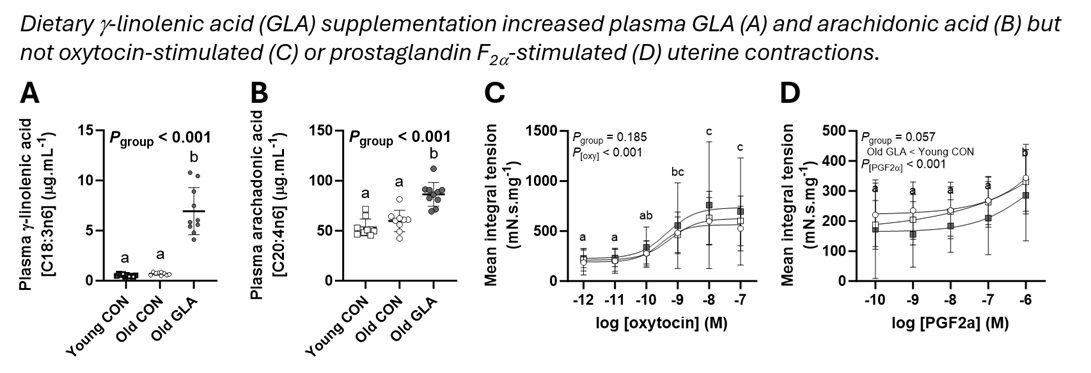
Results: Old CON mice had more resorptions, lower Connexin-43 mRNA expression and smaller PGF2α-stimulated uterine muscle contraction amplitude than young CON mice (each P<0.03). Although plasma concentrations of GLA as well as the prostaglandin precursor arachidonic acid were higher in GLA-supplemented mice (each P<0.001), plasma and placental PGF2α concentrations were similar. Opposing effects of PGF2α on contraction baseline and frequency resulted in similar integral contraction force in Old GLA as Old CON mice.
Conclusions: The reproductive deficits in these multiparous mice were much milder than those reported previously in virgin mice. GLA supplementation had little impact on outcomes in reproductively-aged multiparous mice.
