More than meets the gut: hypercalcaemia and a bariatric curveball (#427)
Primary hyperparathyroidism (PHPT) is less prevalent in people under 30 years with a higher likelihood of a genetic or syndromic aetiology. We describe a 27-year-old male with parathyroid hormone (PTH) dependent hypercalcaemia, with marked biochemical alteration following laparoscopic sleeve gastrectomy (LSG) prompting further evaluation.
The patient was noted to have asymptomatic PTH-dependent hypercalcaemia (serum corrected calcium 2.77 mmol/L and PTH 18.2 pmol/L) during bariatric surgery workup. He had a prior renal calculus as a teenager, and a maternal family history of hypercalcaemia of unclear aetiology. Past medical history included metabolic syndrome, slipped capital femoral epiphysis, and gout for which he was prescribed allopurinol 100mg daily.
Biochemistry pre-operatively was suggestive of PHPT with fractional excretion of calcium (FECa) 1.87%, and low 25-OH vitamin D of 36 nmol/L. Parathyroid sestimibi and 4-dimensional CT scan demonstrated a 13x9x24 mm mass favoured to be a solitary parathyroid adenoma. There were no other clinical features suggestive of multiple endocrine neoplasia, and plasma metanephrine, normetanephrine, and 3-methoxy tyramine were not elevated. Post-LSG, his corrected calcium normalised (2.46 mmol/L), with more mild elevation of PTH (10 pmol/L), low 25-OH vitamin D (40 nmol/L), and low FECa at 0.46%. This was in the setting of significant weight loss equivalent to 46% of his initial body weight 12-months following LSG (current weight 107.8kg from 200kg).
Sleeve gastrectomy alters calcium absorption through reduced gastric acid production and accelerated gastric emptying (1), with vitamin D deficiency being common (2). Investigation of PHPT following bariatric surgery therefore requires careful evaluation as secondary hyperparathyroidism is common in this clinical context. Genetic evaluation in young patients is recommended (3), noting that familial hypocalciuric hypercalcaemia (FHH) may coexist with parathyroid adenoma in atypical cases (4). The patient has been referred for genetic testing for FHH and other hereditary causes prior to further surgical review.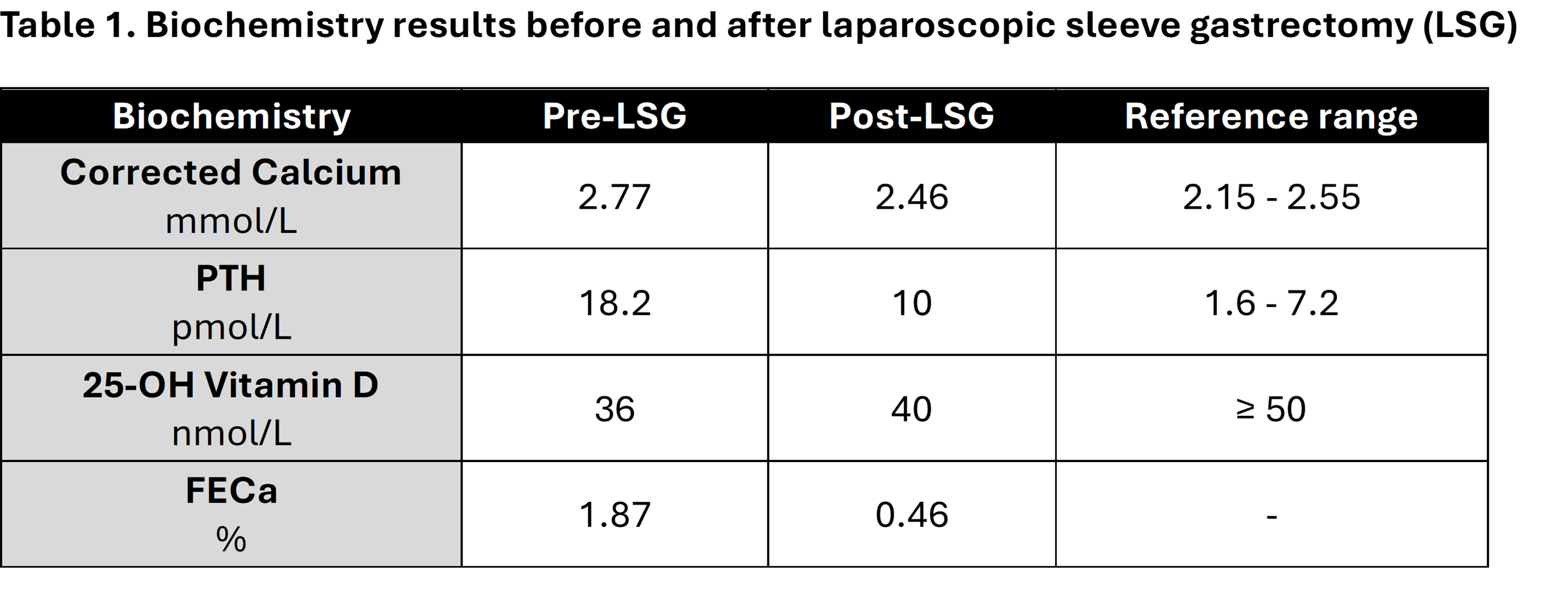
- Wu KC, Cao S, Weaver CM, King NJ, Patel S, Kim TY, Black DM, Kingman H, Shafer MM, Rogers SJ, Stewart L, Carter JT, Posselt AM, Schafer AL. Intestinal calcium absorption decreases after laparoscopic sleeve gastrectomy despite optimization of vitamin D status. J Clin Endocrinol Metab. 2023 Jan 17;108(2):351-360. doi: 10.1210/clinem/dgac579
- Corbeels K, Verlinden L, Lannoo M, Simoens C, Matthys C, Verstuyf A, Meulemans A, Carmeliet G, Van der Schueren B. Thin bones: Vitamin D and calcium handling after bariatric surgery. Bone Rep. 2018 Feb 2;8:57-63. doi: 10.1016/j.bonr.2018.02.002.
- De Sousa SMC, Carroll RW, Henderson A, et al. A contemporary clinical approach to genetic testing for heritable hyperparathyroidism syndromes. Endocrine 75, 23–32 (2022). https://doi.org/10.1007/s12020-021-02927-3
- Mouly C, Vargas-Poussou R, Lienhardt A, et al. Clinical characteristics of familial hypocalciuric hypercalcaemia type 1: A multicentre study of 77 adult patients. Clin Endocrinol (Oxf). 2020; 93: 248–260. doi: 10.1111/cen.14211