A curious case of carcinoid (#419)
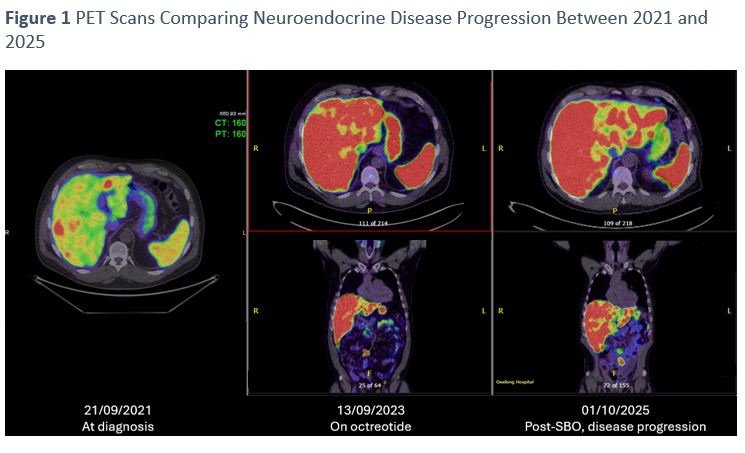
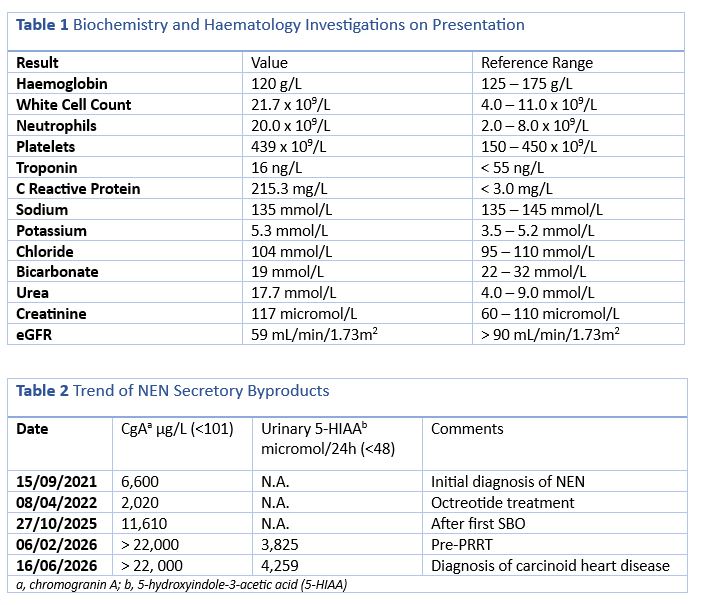
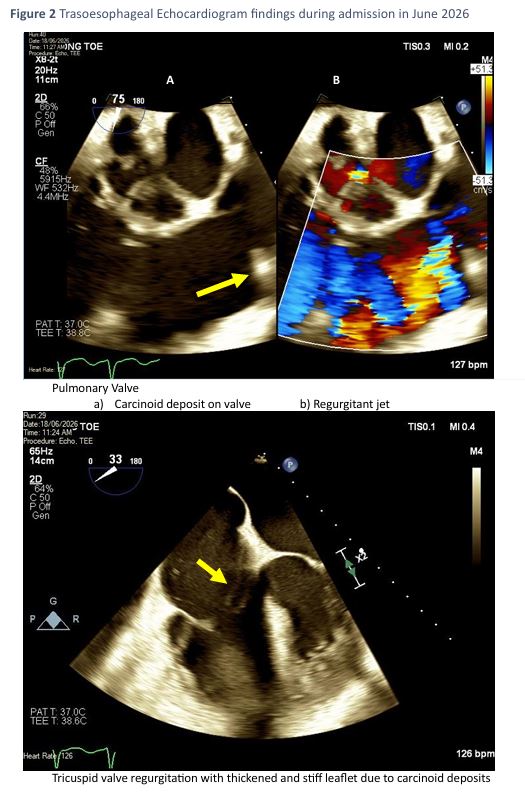
A 58-year-old man with widespread metastatic Grade 1 small bowel neuroendocrine neoplasia (NEN) (Figure 1) presented in cardiogenic shock. Previously stable on Octreotide, he had a one-week history of exertional dyspnoea, cough, pleuritic chest pain and peripheral oedema. His somatostatin analogue (SSA) had been withheld four weeks prior to recent peptide receptor radionuclide therapy and had not been recommenced. Initial investigations revealed atrial flutter with 2:1 conduction, raised inflammatory markers, and markedly elevated chromogranin A and 5-hydroxyindoleacetic acid (Table 1, Table 2). He was refractory to antimicrobials and conventional rate/rhythm control, requiring inotropic and vasopressor support. Transoesophageal echocardiography (TOE) confirmed torrential tricuspid regurgitation, thickened leaflets, and right ventricular dilatation with reduced systolic function (Figure 2).
Given the antecedent symptoms preceding presentation and temporary cessation of the SSA, we conclude that infection acted as a trigger which accelerated his pre-existing but subclinical carcinoid heart disease (CHD) and precipitated cardiogenic shock. He underwent TOE-guided DC-cardioversion and was commenced on an octreotide infusion of 50–100µg/hour. Dosing was extrapolated from perioperative prophylaxis recommendations given the absence of international guidelines for carcinoid crisis or CHD. Vasopressors were subsequently withdrawn, and he is awaiting percutaneous valve surgery.
CHD is a well-recognised complication of carcinoid syndrome (CS), occurring in up to 60% of affected patients (1). Systemic circulation of vasoactive amines results in CHD by activating cardiac serotonin receptors. The ensuing release of tissue growth factor-β2 causes extracellular matrix and collagen synthesis from cardiac interstitial cells, leading to endocardial fibrous deposition, valvopathy and myocardial dysfunction (2,3). Right-sided heart failure with tricuspid regurgitation are near-universal signs of CHD.
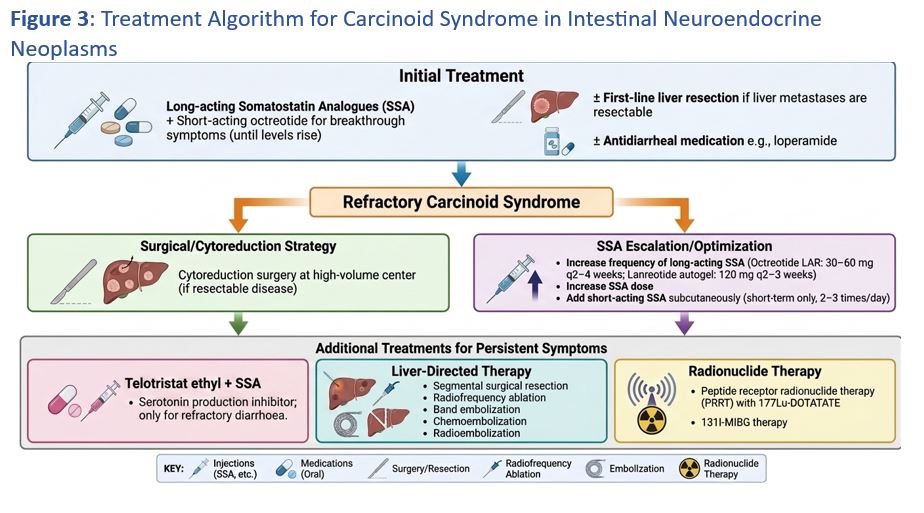
Treatment of CS with SSA’s provides symptomatic relief but doesn’t improve overall survival (Figure 3) (4). This case highlights the challenge in treatment distinguishing CS from progressive CHD and other causes of cardiogenic shock in patients with known NEN's.
- Perez K, Del Rivero J, Kennedy EB, et al. Symptom Management for Well-Differentiated Gastroenteropancreatic Neuroendocrine Tumors: ASCO Guideline. JCO Oncol Pract. 2026;22(1):19-35. doi:10.1200/OP-25-00133
- Jian B, Xu J, Connolly J, et al. Serotonin mechanisms in heart valve disease I: serotonin-induced up-regulation of transforming growth factor-beta1 via G-protein signal transduction in aortic valve interstitial cells. Am J Pathol. 2002;161(6):2111-2121. doi:10.1016/s0002-9440(10)64489-6
- Waltenberger J, Lundin L, Oberg K, et al. Involvement of transforming growth factor-beta in the formation of fibrotic lesions in carcinoid heart disease. Am J Pathol. 1993;142(1):71-78.
- Rinke A, Wittenberg M, Schade-Brittinger C, et al. Placebo-Controlled, Double-Blind, Prospective, Randomized Study on the Effect of Octreotide LAR in the Control of Tumor Growth in Patients with Metastatic Neuroendocrine Midgut Tumors (PROMID): Results of Long-Term Survival. Neuroendocrinology. 2017;104(1):26-32. doi:10.1159/000443612