Combination osilodrostat and tolvaptan for ectopic Cushing’s syndrome (#418)
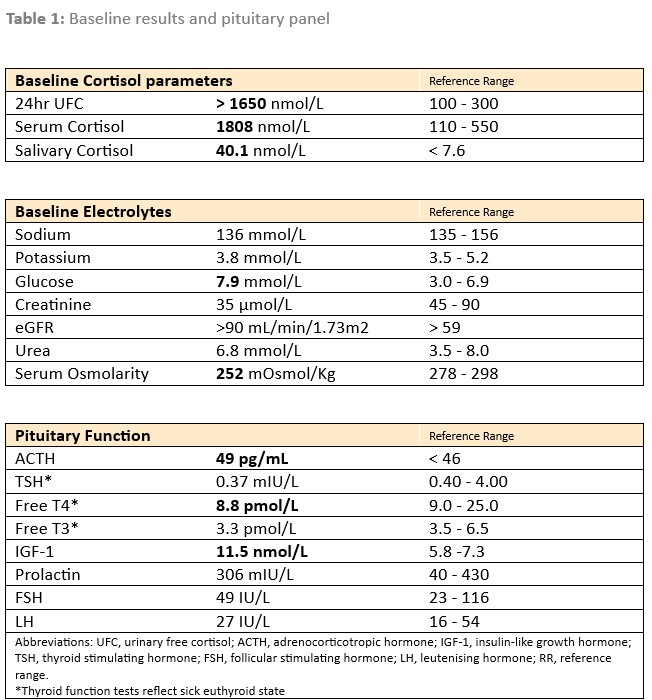
A 55-year-old female with metastatic small cell lung carcinoma presented with severe hypertension, peripheral oedema, hypokalaemia and hyponatraemia. Diagnostics confirmed an ectopic Cushing’s syndrome (CS) with co-secretion of adrenocorticotrophic hormone (ACTH) and antidiuretic hormone (ADH). Results are summarised in Table 1.
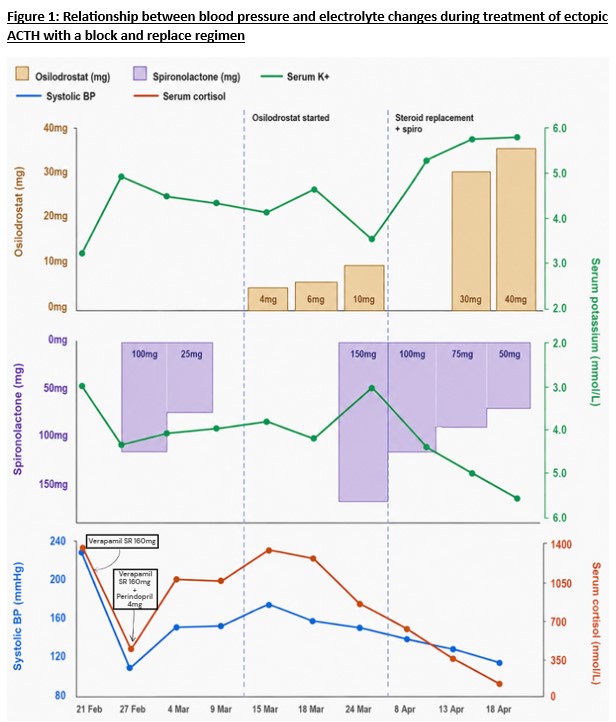
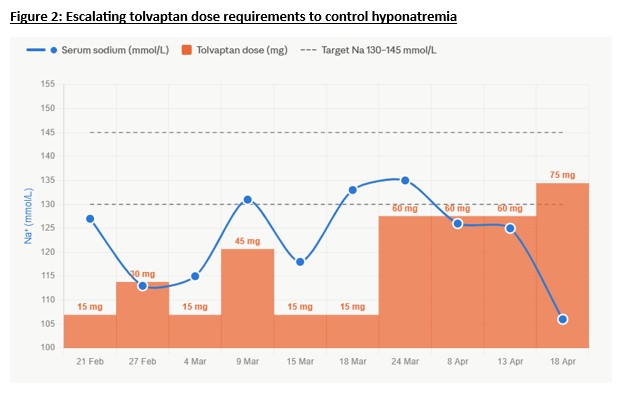
Our patient’s hypertension resulted from maximum ACTH-driven glucocorticoid and mineralocorticoid receptor (MR) activity, as well as high circulating ADH. Concurrent hypokalaemia in this setting required the early introduction of spironolactone. After initial improvement in blood pressure, she commenced low dose osilodrostat. She was quickly titrated to a block-and-replace (B&R) regimen, initially using hydrocortisone. Hydrocortisone was replaced by dexamethasone to reduce MR stimulation, and osilodrostat was escalated to a final total daily dose of 40mg (Figure 1). Tolvaptan was titrated to correct hyponatraemia (Figure 2).
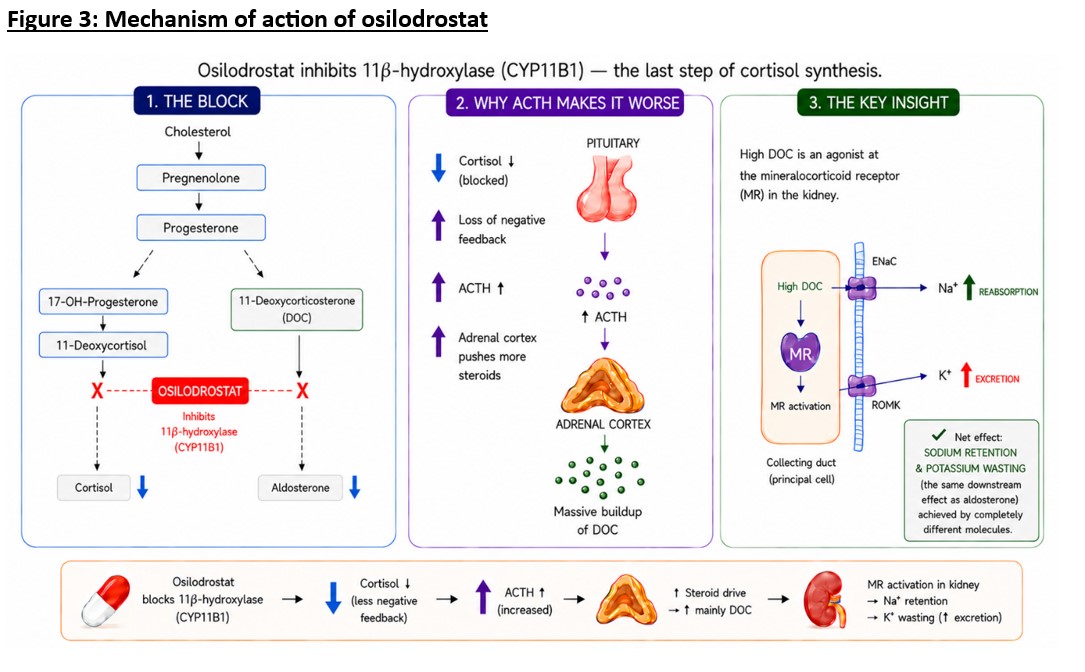
Osilodrostat, a potent oral 11β-hydroxylase inhibitor is new in the treatment of Cushing’s syndrome (1, 2). Paradoxically, rapid titration in B&R strategy often necessitates MR blockade to reduce 11-deoxycortisone effect on MR’s and control hypokalaemia (3) (Figure 3). ADH co-secretion is well documented in ectopic CS and the use of tolvaptan in this case in combination adds to the case reports in literature (4). Dexamethasone has lower cross reactivity with serum cortisol immunoassay and has little mineralocorticoid effect making it the ideal replacement glucocorticoid.
This case highlights the layered electrolyte consequences of ectopic ACTH and ADH co-secretion, both in the untreated state and during therapy. Osilodrostat-mediated cortisol blockade unmasked significant mineralocorticoid excess driven by ACTH-stimulated deoxycorticosterone, requiring concurrent mineralocorticoid receptor antagonism. The escalating doses of both osilodrostat and tolvaptan needed to achieve biochemical control reflect the progressive and aggressive trajectory of her disease.
- Fleseriu M, Biller BMK. Treatment of Cushing’s syndrome with osilodrostat: practical applications of recent studies with case examples. Pituitary. 2022;25(6):795-809. doi:10.1007/s11102-022-01268-2
- Gadelha M, Bex M, Feelders RA, et al. Randomized Trial of Osilodrostat for the Treatment of Cushing Disease. J Clin Endocrinol Metab. 2022;107(7):e2882-e2895. doi:10.1210/clinem/dgac178
- Castinetti F, Bertherat J, Chanson P, Raverot G, Young J, Tabarin A. Use of osilodrostat in a block-and-replace and titration strategy for cushing’s syndrome: a position paper by French experts. Rev Endocr Metab Disord. Published online 2026. doi:10.1007/s11154-026-10020-1
- Müssig K, Horger M, Häring HU, Wehrmann M. Syndrome of inappropriate antidiuretic hormone secretion and ectopic ACTH production in small cell lung carcinoma. Lung Cancer. 2007 Jul;57(1):120-2. doi: 10.1016/j.lungcan.2007.03.003. Epub 2007 Apr 5. PMID: 17418447.