Comparative Effects of Exercise Modalities on Bone Mineral Density During Weight Loss Among People with Obesity: A Systematic Review and Network Meta-Analysis (#374)
Weight loss through caloric restriction reduces bone mineral density (BMD) in adults with obesity, raising concern about fracture risk. Exercise is often recommended to mitigate BMD loss, but which modality is most effective remains unclear. We conducted a systematic review and network meta-analysis (NMA) comparing the effectiveness resistance, aerobic, and combined exercise, and physical activity counselling, added to weight-loss interventions, for preserving whole-body, hip, and lumbar spine BMD during weight loss in adults with obesity.
We searched MEDLINE, Embase, and CENTRAL (from inception until 5th of November 2025) for randomised controlled trials of adults with obesity (BMI ≥30 kg/m²) comparing resistance, aerobic, or combined exercise, or physical activity counselling, added to a weight-loss intervention of ≥12 weeks, against diet alone or usual care, and reporting BMD by dual-energy X-ray absorptiometry. Random-effects NMAs were performed separately for each skeletal site, with weight-loss diet alone as the reference comparator. Risk of bias was assessed using RoB 2, and certainty was evaluated using GRADE adapted for network meta-analysis (PROSPERO CRD420251180208).
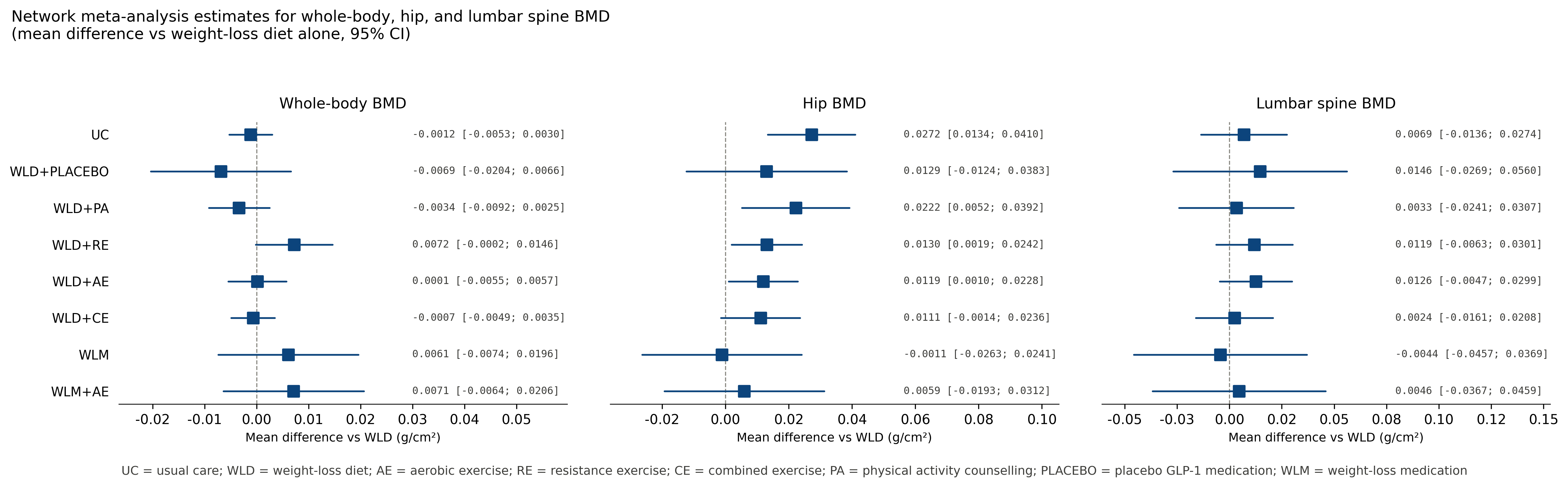
Twenty-four trials were included (n=5,188 participants). For whole-body and lumbar spine BMD, no exercise modality showed a significant effect on mitigating BMD loss versus diet alone. For hip BMD, aerobic exercise, resistance exercise, and physical activity counselling showed a mitigation effect versus diet alone (mean differences 0.012–0.022 g/cm², 95% confidence intervals excluding zero). However, node-splitting revealed significant inconsistency in loops involving aerobic and resistance exercise comparisons (p<0.05), warranting caution. The physical activity counselling estimate was based entirely on indirect evidence (k=0 direct studies).
Resistance and aerobic exercise may modestly attenuate hip BMD loss during weight loss, but this signal is undermined by network inconsistency. Physical activity counselling showed a similar effect. No differential effects on BMD preservation were found at the whole-body or lumbar spine sites.