Obesity and excess weight before and after heart transplantation: A retrospective audit (#373)
Background: Obesity is common among patients awaiting heart transplantation (HTx), yet the prevalence and trajectory of weight change after HTx is not well described.
Aim: To describe the prevalence of weight change and obesity before and 12 months after HTx, and explore factors associated with post-transplant weight change.
Methods: Retrospective audit of adult HTx recipients using medical records of HTx recipients from January 2021 to June 2023. World Health Organisation categorisation of body mass index (BMI) was used.
Results: Records were reviewed for 96 HTx recipients. Pre-transplant, 4% of patients were underweight, 33% healthy weight, 33% overweight and 29% obese. At 12 months there had been relatively little change in the proportion of patients who were overweight or obese, with 4% underweight, 34% healthy weight, 41% overweight and 21% obese.
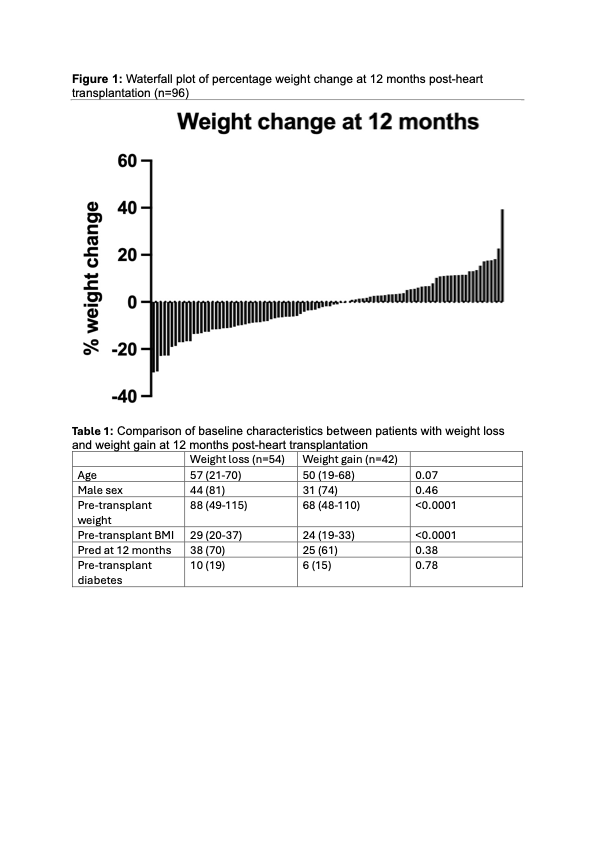
At 12 months, 54 (56%) patients had lost weight or remained stable and 42 (44%) had gained weight.(Figure 1) The two groups did not differ significantly in age (57 vs 50 years, p=0.07) or sex (81% vs 74% male, p=0.46). Patients who lost weight had significantly higher pre-transplant BMI (29kg/m² vs 24kg/m², p<0.0001) than those who gained weight. Glucocorticoid exposure (70% vs 61%, p=0.38) and pre-transplant diabetes (19% vs 15%, p=0.78) did not differ significantly between groups.(Table 1)
Conclusion: While the literature often suggests glucocorticoid exposure as the predominant contributor to weight change after HTx, pre-transplant weight and BMI were most strongly associated with weight change in this cohort. Weight loss occurred more often among patients with higher pre-transplant BMI, while weight gain was more common among those with lower baseline BMI, consistent with a shift toward a healthier BMI distribution rather than a uniform steroid-driven gain. Notably, the majority of HTx patients in this cohort were overweight or obese before transplantation, highlighting that metabolic risk predates transplant itself.