Obesity burden in a tertiary Australian health service: a point prevalence study (#349)
Aims:
Obesity is rising globally and represents a major health system burden. Obesity is associated with multiple comorbidities, which increases health-care utilisation and complexity (1)(2)(3). The current prevalence of obesity within hospital settings is unclear, impacting health care service planning. We sought to quantify the prevalence of overweight, obesity and associated comorbidities in patients admitted to two hospitals in Western Australia.
Methods:
A point prevalence study was conducted using data collected by the dietetics department at both a large teaching hospital and at one of its affiliate secondary hospital sites. Height and weight were prospectively collected for body mass index (BMI) calculation. Of 489 inpatients surveyed, 436 (89.2%) had sufficient data for inclusion. Overweight was defined as a BMI 25-29.9 kg/m2 and obesity as BMI >30 kg/m2. A retrospective review of digital medical records was performed to identify obesity-related comorbidities. Groups were compared using Chi-square test or Cochrane-Armitage trend test for categorical variables or linear regression for continuous variables, with a p<0.05 defined as statistically significant.
Results:
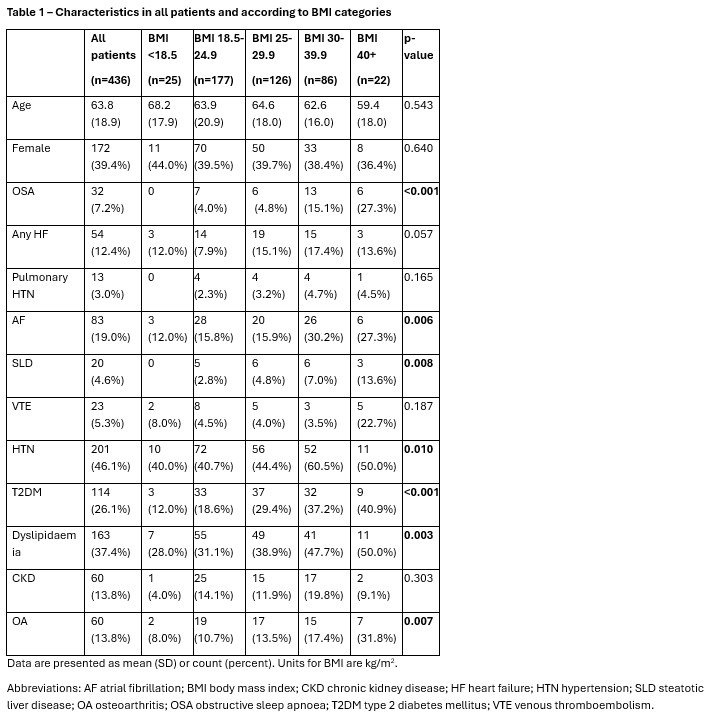
Of 436 patients, 25 (5.7%) had a BMI <18.5 kg/m2, 177 (40.6%) had a BMI 18.5-24.9 kg/m2, 126 (28.9%) were overweight and 108 (24.8%) had obesity (Table 1). Of patients with obesity, only 21 (19.4%) had obesity coded in the discharge summary as a comorbidity. The prevalence of obesity in the surgical wards was significantly higher than medical wards (30.1% vs 20.6%; p=0.024). Obesity was significantly associated with obstructive sleep apnoea, atrial fibrillation, steatotic liver disease, hypertension, type 2 diabetes, dyslipidaemia and osteoarthritis (p<0.05 for all).
Conclusion:
This two-centre point prevalence study demonstrates that approximately 1 in 2 patients admitted in hospital are overweight or obese, with 1 in 4 being obese. Higher BMI was associated with several comorbidities, highlighting the increased care burden and complexity associated with obesity in hospitalised patients.
- 1. Organization WH. Obesity and overweight. 2021. https://www.who.int/news-room/fact-sheets/detail/obesity-and-overweight
- 2. Buchmueller TC, Johar M. Obesity and health expenditures: evidence from Australia. Econ Hum Biol. 2015 Apr;17:42-58. doi: 10.1016/j.ehb.2015.01.001. Epub 2015 Jan 16. PMID: 25637887.
- 3. Korda RJ, Joshy G, Paige E, Butler JR, Jorm LR, Liu B, Bauman AE, Banks E. The relationship between body mass index and hospitalisation rates, days in hospital and costs: findings from a large prospective linked data study. PLoS One. 2015 Mar 4;10(3):e0118599. doi: 10.1371/journal.pone.0118599. PMID: 25739093; PMCID: PMC4349828.