Coronary artery calcification attenuates the skeletal benefits of anti-resorptive therapy (#348)
Cardiovascular disease is associated with low bone mineral density (BMD) and fracture risk, however no good biomarker exists that identifies who is at risk.1 We aimed to investigate whether the presence of CAC affects BMD changes over time in a cohort of anti-resorptive (ART) users.
This was a retrospective review of the electronic medical records of Monash Health, Melbourne, Australia. Patients were eligible if they (1) had CAC assessment by cardiac CT (CTCA), (2) dispensed ART prior to CTCA, and (3) had DEXA BMD assessment within 2 years of CTCA. Only patients with a follow up DEXA were included in the final analysis. Follow-up duration was the interval from baseline to follow-up DEXA. The primary outcome was between-group differences in femoral neck and total hip BMD between CAC-present and CAC-absent individuals. Differences in BMD change were estimated as the average marginal effect and adjusted for age, sex, smoking, and BMI; with correction for multiple comparisons.
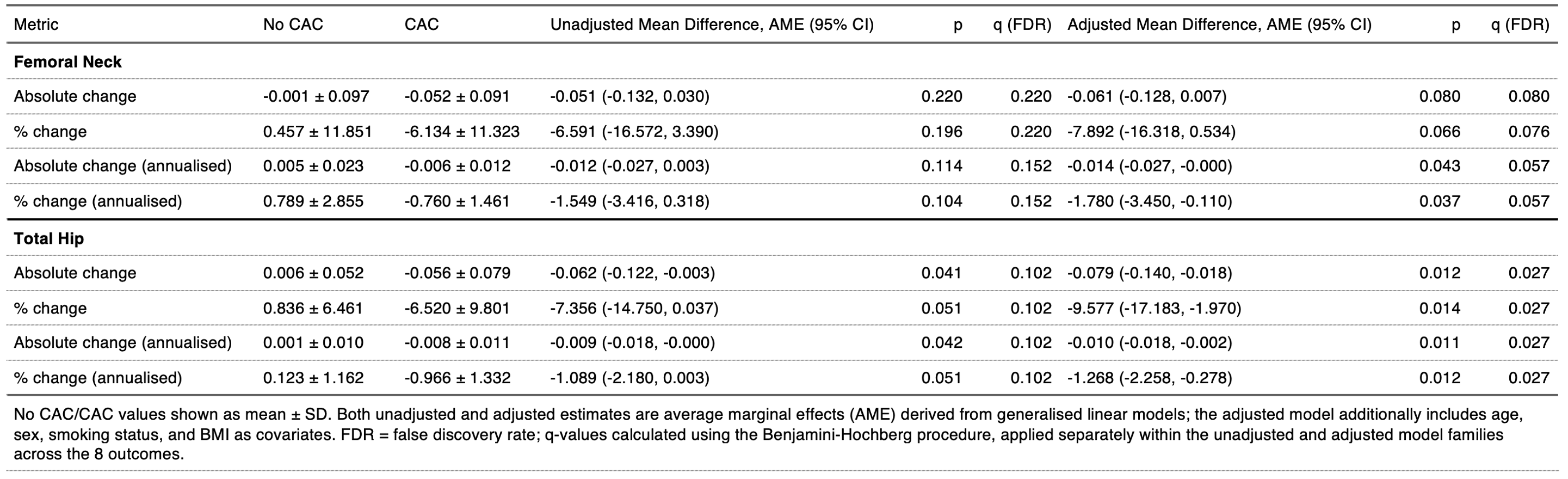
Here we report on preliminary data of 21 patients identified thus far; 12 had evidence of CAC. Mean age of the cohort was 60.8 (±7.8) years, and majority were men (17, 81%). Most participants were never-smokers (10, 56%), and there was no significant difference in the proportion of major cardiovascular risk factors between the groups. The most frequently dispensed ART was zoledronic acid (10, 48%), denosumab (9, 43%) and oral bisphosphonates (3, 14%). At repeat imaging, those without CAC had an increase in BMD, whereas those with CAC had a decrease in BMD. The between-group difference was statistically significant which was maintained after adjustment for multiple comparisons (Table 1).
These preliminary data suggest that, despite ART, BMD changes in those with CAC were attenuated compared those without CAC. Analyses on the complete cohort are underway to validate these findings.
- 1. Zeng X, Wang D, Yang H, Liu Z, Li X, Xiong T, et al. Association between bone mineral density and coronary artery calcification: an updated systematic review and meta-analysis. BMC Cardiovasc Disord. 2026;26(1)