VCP-associated multi-system proteinopathy – a rare genetic cause of atypical Paget’s disease of bone (#408)
Paget’s disease of bone (PDB) is a common metabolic bone disorder characterised by focal disorganised bone remodelling. Up to 40% of PDB cases are familial, mostly attributable to SQSTM1 mutations.(1) Valosin-containing protein (VCP) mutations cause a rare, autosomal dominant multisystem proteinopathy (MSP), combining inclusion body myopathy, frontotemporal dementia, and/or PDB.(2-4) PDB occurs in approximately 40% of MSP cases, with typically early-onset, polyostotic disease, often sparing long bones.(2-4)
We present a 54-year-old male with rapidly progressive polyostotic bone pain and bilateral hearing loss, with a 3-year history of progressive lower limb weakness and falls. Family history was significant for PDB spanning three generations, with his mother also developing lower limb weakness and dementia. Lower limb examination revealed a waddling gait, proximal leg weakness and muscle atrophy with preserved sensation.
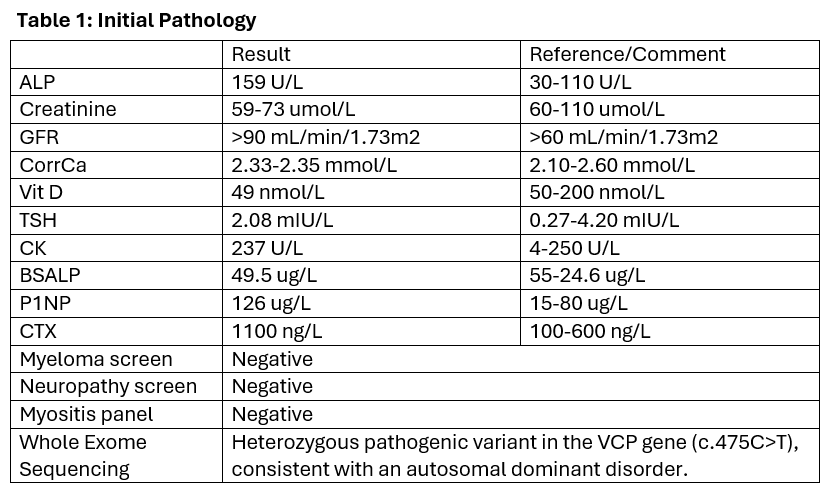
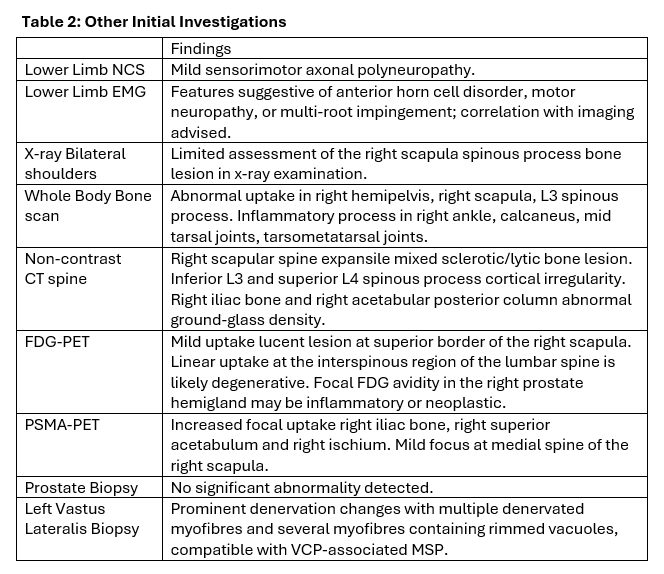
Pathology demonstrated persistent, isolated raised ALP and bone turnover markers (Table 1). X-ray, CT, PET and bone scan demonstrated atypical multifocal lytic/sclerotic lesions, initially making the diagnosis challenging and raising concern for differentials including metastatic prostate malignancy. The bone lesions were PSMA positive on PET scan, but prostate biopsy was benign. As PDB is known to be PSMA positive, a diagnosis of atypical PDB was made. Extensive investigations (Table 2) culminated in whole exome sequencing identifying a pathogenic VCP c.475C>T variant, unifying the skeletal, neuromuscular and familial findings as MSP.
His PDB was managed with zoledronic acid with normalisation of ALP. He has been counselled on MSP with multidisciplinary involvement to optimise mobility, pain and function with surveillance for neurocognitive deterioration.
Although the majority of genetic PDB relates to SQSTM1, this case illustrates that in atypical presentations, particularly early-onset polyostotic disease occurring with a family history of unexplained myopathy, weakness or dementia, should prompt consideration of rarer genetic causes such as VCP-MSP.
- You, Y. et al. (2023) ‘Molecular test of paget’s disease of bone in families not linked to SQSTM1 gene mutations’, Bone Reports, 18, p. 101670. doi:10.1016/j.bonr.2023.101670.
- Pfeffer, G. et al. (2022) ‘Multisystem proteinopathy due to VCP mutations: A review of clinical heterogeneity and genetic diagnosis’, Genes, 13(6), p. 963. doi:10.3390/genes13060963.
- Al‐Obeidi, E. et al. (2017) ‘Genotype‐phenotype study in patients with valosin‐containing protein mutations associated with multisystem proteinopathy’, Clinical Genetics, 93(1), pp. 119–125. doi:10.1111/cge.13095.
- Abdoalsadig, E. et al. (2025) ‘Utilization of CORDS registry to monitor quality of life in patients with VCP multisystem proteinopathy’, Orphanet Journal of Rare Diseases, 20(1). doi:10.1186/s13023-025-03567-w.