Positive Allosteric Modulation of Human and Chicken Calcium-Sensing Receptors by CySSG and Caffeine (#269)
The calcium-sensing receptor (CaSR) is a class C G protein-coupled receptor that plays an essential role in extracellular calcium homeostasis. Besides Ca2+, several positive allosteric modulators (PAMs) have been identified, including amino acids, γ-glutamyl peptides, glutathione-related compounds, and caffeine. Recent genome-wide association studies (GWAS) revealed genetic associations among glutathione metabolism, serum cysteine-glutathione disulfide (CySSG), and serum calcium (Ram, this meeting), suggesting that CySSG may contribute to CaSR-mediated calcium homeostasis. However, whether the modulatory effects of CySSG and caffeine are conserved across vertebrate species remains unknown.
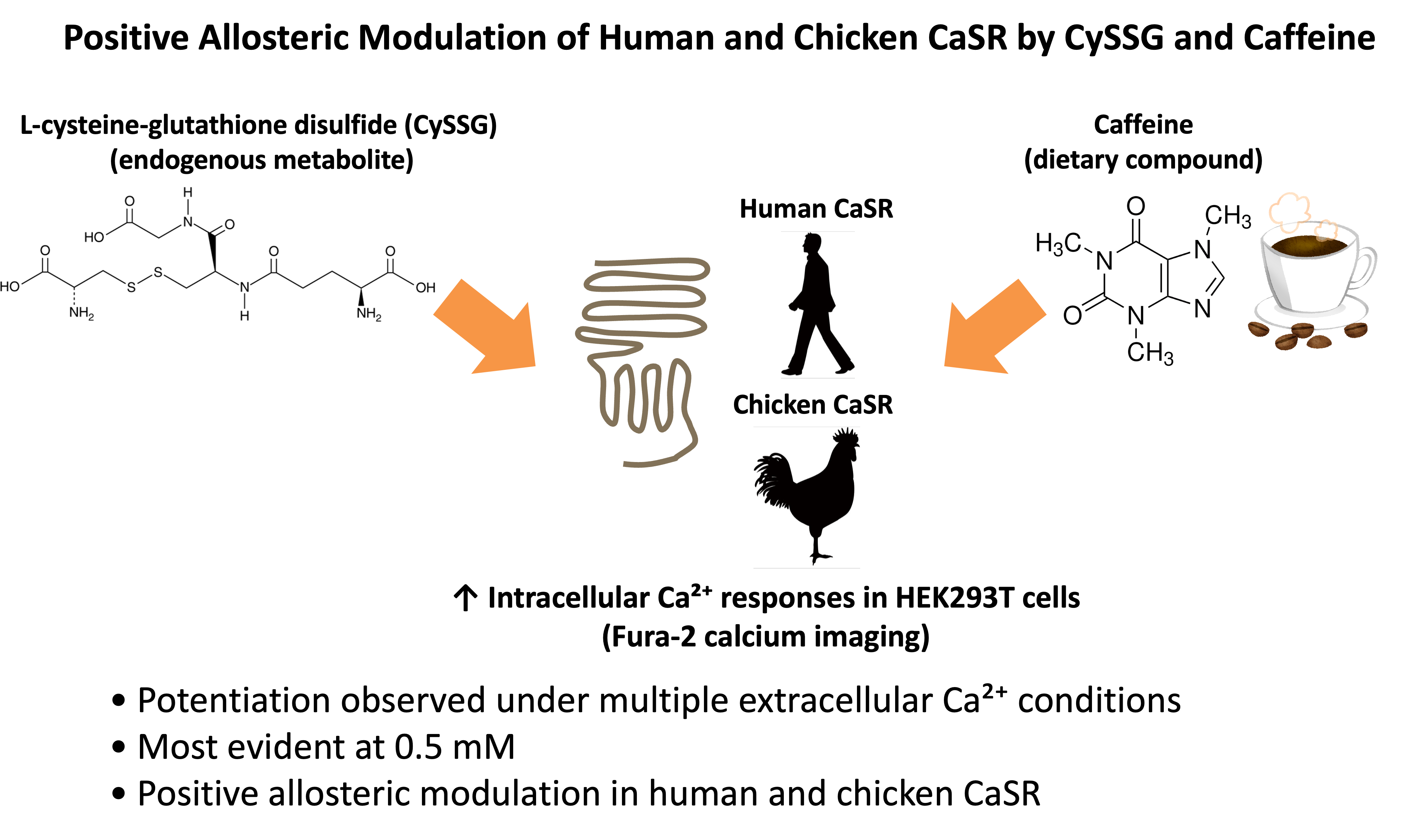
We therefore examined effects of CySSG and caffeine on human and chicken CaSR using calcium imaging. HEK293T cells transiently expressing human or chicken CaSR were loaded with the fluorescent Ca2+ indicator Fura-2 48 h after transfection. Intracellular Ca2+ responses were measured in separate wells in response to extracellular Ca2+ application of 0.5, 1.5, 2.5, and 5.0 mM in the presence of CySSG (0.1–30 μM) or caffeine (0.1–50 μM).
Ca2+ responses in both human CaSR- and chicken CaSR-expressing cells were enhanced by CySSG as low as 0.1 μM. Caffeine also enhanced CaSR-mediated responses in both species. Potentiation was strongest at 0.5 mM extracellular Ca2+ and was also present at 1.5 mM and 2.5 mM Ca2+.
The major outcome of this study is that CySSG and caffeine are suggested to act as PAMs for both human and chicken CaSR. Potentiation tended to be greater under non-physiological extracellular Ca2+ conditions than under near-physiological Ca2+ concentrations. These findings support the possibility that this regulatory mechanism is conserved across vertebrate species and provide a foundation for future studies investigating the physiological significance of CySSG and the pharmacological effects of caffeine on CaSR function.
Acknowledgements: The author thanks Dr. Jeffrey L. Ram for insightful discussions and for inspiring this study through his pioneering work on glutathionergic regulation of CaSR.