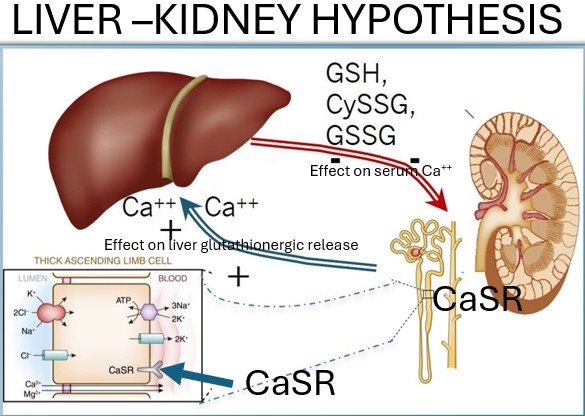
GWAS data and the hypothesis of hepatic glutathionergic regulation of serum calcium via a CaSR-mediated mechanism (#270)
Genome-wide association studies can show significant associations of seemingly unrelated responses due to previously unrecognized physiological interactions. Simulated docking and experimental competitive binding indicate that glutathione (GSH) and its oxidized derivatives glutathione disulfide (GSSG) and cysteine glutathione disulfide (CySSG) can bind to extracellular calcium receptors (CaSR) at the amino acid/peptide binding site in the extracellular domain of CaSR. Glutathionergics sensitize CaSR to calcium (see Kawabata, this conference). We hypothesized that mutations in genes coding for enzymes mediating glutathionergic metabolism would have significant associations with both serum glutathionergic products and serum calcium.
Aggregated GWAS data on genes mediating glutathione metabolism were investigated for significant associations with serum calcium, using GWAS Catalog and NLM’s dbSNP websites and personal communications. Associations reported here highlight data sourced from Hannan & Mahajan (2023), Feofanova et al. (2020), and Sakue et al. (2021).
No significant associations with calcium were found for synthetic enzymes GCL, GCLC, GCLM, GSS, and GR. Glutathione peroxidase (GPX) has two significant mutations; however, the genes with the most significant associations with serum calcium are gamma-glutamyltranspeptidase (GGT1, e.g, mutation rs5760495, p<E-11) and dipeptidase (DPEP, e.g., mutation rs258341, p<E-27). MRP (ABCC transporters) associations with Ca vary by study. Significantly, several of these mutations that are associated with serum Ca also report significant associations with serum CySSG (e.g., GGT1, rs5760495, p<E-36 and ABCC, rs60782127, p<E-23). Other significant associations are with CySSG degradation products.
The major outcome of this study is that GWAS analyses support associations between glutathione metabolism and regulation of serum Ca. Cognate associations with other functions that might be affected by calcium regulation include effects of glutathione-regulating genes on bone tissue density and stature. Serum glutathionergics primarily come from the liver; significant genetic associations may disrupt the influence of hepatic glutathionergics on calcium regulation via changes in CaSR sensitivity to serum calcium.