Low Bone Mineral Density Unmasking Metabolic dysfunction Associated Steatotic Liver Disease Related Compensated Cirrhosis with Portal hypertension : The Liver-Bone Axis (#406)
Background
Severe osteoporosis in young adults warrants evaluation for secondary causes. Metabolic dysfunction associated steatotic liver disease (MASLD), can progress silently to compensated cirrhosis with portal hypertension and cause hepatic osteodystrophy. We report a case illustrating the liver-bone axis in MASLD-related compensated cirrhosis with severe osteoporosis.
Case Study:
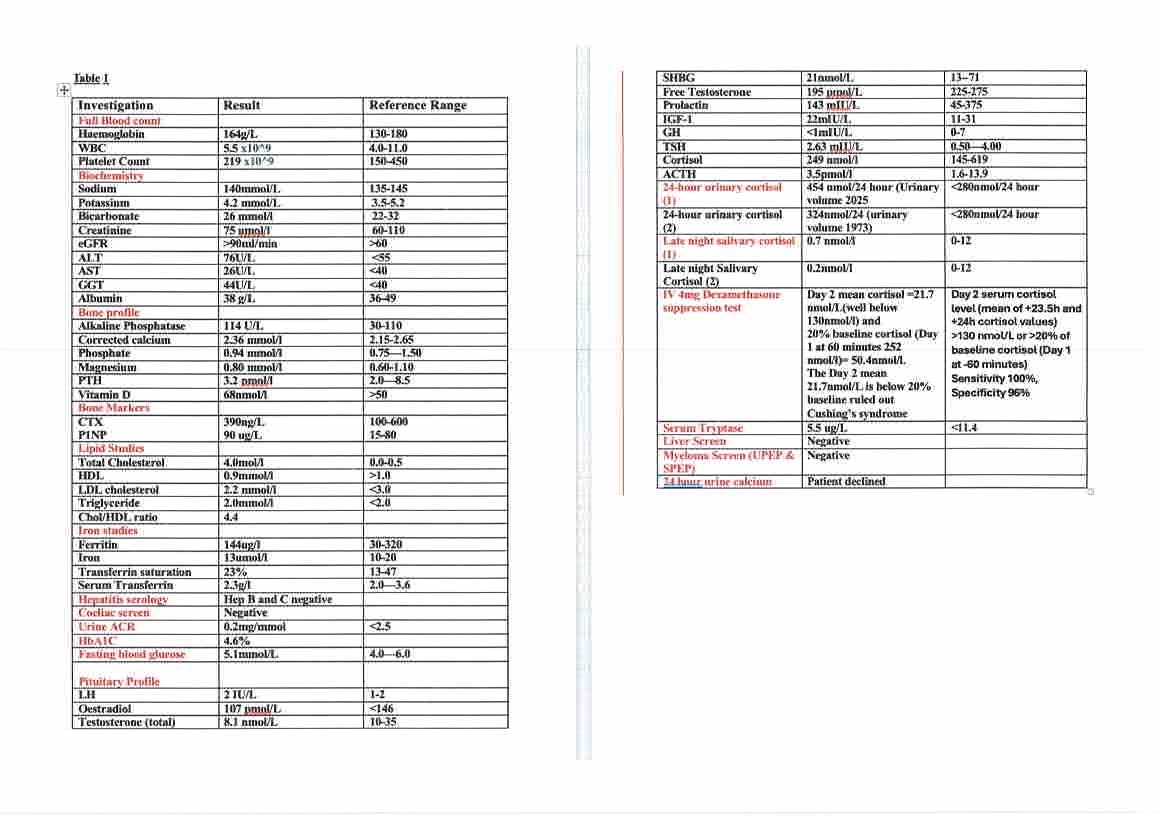
A 37-year-old male with morbid obesity (BMI 43kg/m2), severe OSA on CPAP, receiving Semaglutide 0.5mg weekly presented with low energy , intermittently reduced libido, a 2cm height loss, back pain without preceding trauma or fractures. He neither smoked nor consumed alcohol. No additional osteoporosis risk factors were identified. Examination demonstrated mild thoracic kyphosis, normal testicular volume bilaterally with no clinical signs of Cushing’s syndrome, hyperthyroidism, hypogonadism, joint laxity or blue sclera. During evaluation for Cushing’s syndrome, DEXA scan demonstrated severe osteoporosis at the spine (Z score -2.8) with 18-20% anterior T11 height loss observed on lateral thoracic spine X-ray. Other secondary causes of osteoporosis including Cushing’s syndrome were excluded (Table 1) with normal pituitary MRI. Abnormal liver function tests prompted liver ultrasound, which reported liver cirrhosis with portal hypertension and splenomegaly. Hepatic osteodystrophy was diagnosed, romosuzumab commenced.
Conclusion
Severe osteoporosis may be an important clinical clue to occult MASLD-related compensated cirrhosis. In young adults with unexplained low bone mineral density after exclusion of secondary causes, clinicians should consider underlying chronic liver disease, particularly in the presence of obesity and metabolic risk factors.
Discussion
Osteoporosis affects 20-50% of cirrhotic patients1, 2.Proposed mechanisms; reduced hepatic IGF-1production, chronic inflammatory mediators (IL-6 and TNF -alpha), impaired osteoblast function and increased bone resorption3. This case highlights that unexplained low bone mineral density may be an early marker of occult MASLD-related compensated cirrhosis.4,5
- 1.Goral V et al. Hepatic osteodystrophy and liver cirrhosis. World J Gastroenterol 2010;16(13):1639–43. 2. Jeong HM et al, Kim DJ. Bone diseases in patients with chronic liver disease. Int J Mol Sci 2019;20(17) 3. Hongliang Gao et al. Emerging role of liver-bone axis in osteoporosis. Journal of Orthopaedic Translation 48 (2024) 217–231 4. Wakolbinger R, et al. Bone microarchitecture and bone turnover in hepatic cirrhosis. Osteoporosis Int 2019;30(6):1195–204. 5. Xiaowen Zhang et al. Low Bone Mineral Density as a Risk Factor for Liver Cirrhosis. The The Journal of Clinical Endocrinology & Metabolism, 2025, 110, e276–e282